
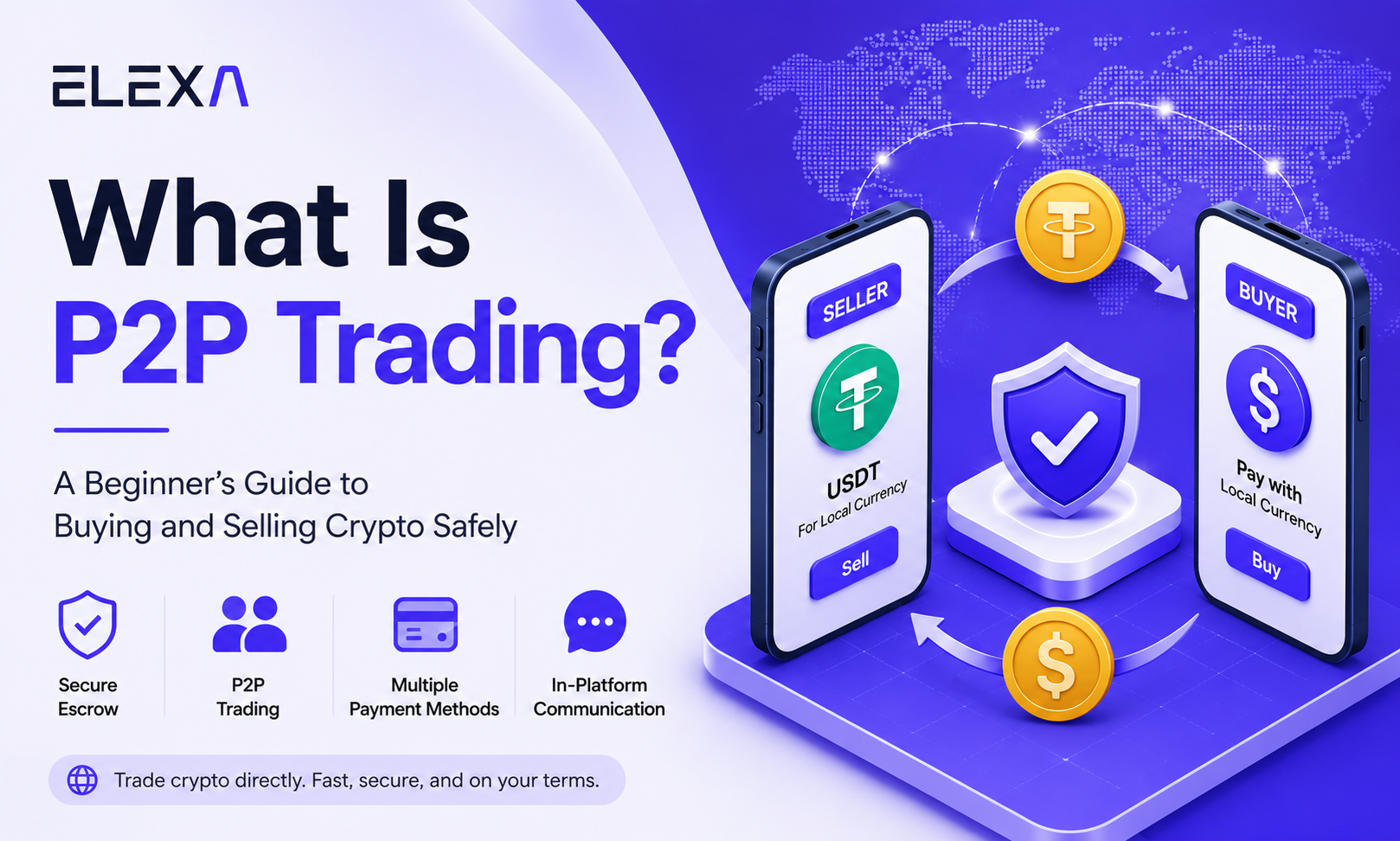
What Is P2P Trading? A Beginner’s Guide to Buying and Selling Crypto Safely
P2P trading is one of the most flexible ways to buy and sell cryptocurrency directly with other people. Instead of trading only through a centralized exchange, users can create or accept offers, choose payment methods, agree on trade terms, and complete transactions through a peer-to-peer marketplace.
For many crypto users, P2P trading offers more control, more local payment options, and better access to digital assets. But because buyers and sellers interact directly, it is important to understand how P2P trading works, what risks exist, and how to trade safely.
In this guide, you’ll learn what P2P trading means, how it works, why people use it, what the main risks are, and how platforms such as Elexa help create a more structured environment for direct crypto trading.
What Does P2P Trading Mean?
P2P stands for peer-to-peer.
In crypto trading, P2P means that one person buys or sells cryptocurrency directly with another person. Instead of the platform being the direct buyer or seller, the platform helps connect users and organize the trade.
For example, one user may want to sell USDT for local currency. Another user may want to buy USDT using a local payment method. A P2P marketplace allows these two users to find each other, agree on a price, follow trade instructions, and complete the transaction.
A simple P2P trade usually involves:
- A seller creating an offer.
- A buyer accepting the offer.
- The buyer sending fiat payment.
- The seller confirming the payment.
- The crypto being released to the buyer.
The exact process may vary depending on the platform, asset, payment method, and local market.
How P2P Crypto Trading Works
A P2P crypto trade usually follows a structured flow.
1. A User Creates an Offer
The process often starts when a user creates an offer to buy or sell crypto.
An offer may include:
- The cryptocurrency being traded
- The price
- The fiat currency
- The minimum and maximum trade amount
- Accepted payment methods
- Trade time limit
- Additional terms or instructions
For example, a seller may create an offer to sell USDT in exchange for local currency using a bank transfer.
A buyer can then review the offer and decide whether to accept it.
2. Another User Accepts the Offer
Once another user accepts the offer, the trade begins.
At this point, both sides should carefully review:
- The amount of crypto
- The fiat amount
- Payment instructions
- Payment method
- Trade timer
- Platform rules
Clear offer terms are important because they reduce confusion and help prevent disputes.
3. The Crypto Is Held During the Trade
Many P2P platforms use escrow protection.
This means that the seller’s crypto is temporarily locked during the trade. The buyer can see that the seller has committed the crypto to the transaction, while the seller still controls when to release it after confirming payment.
Escrow is one of the most important safety mechanisms in P2P trading, but it does not remove the need for careful verification.
The seller must still confirm that the fiat payment has actually arrived before releasing the crypto.
4. The Buyer Sends Payment
The buyer sends payment using the payment method listed in the offer.
This could be a bank transfer, local payment app, mobile money method, or another supported payment option depending on the platform and region.
The buyer should follow the instructions exactly.
They should not:
- Use a different payment method without approval
- Send payment from a third-party account if not allowed
- Claim payment was made before actually paying
- Ask the seller to release crypto early
- Move the conversation outside the platform
A clean payment process protects both sides.
5. The Seller Confirms Payment
After the buyer sends payment, the seller must verify it.
This is one of the most important steps in P2P trading.
The seller should check their own bank account or payment app and confirm:
- The payment arrived
- The amount is correct
- The payment is not pending
- The sender details match the trade requirements
- The payment method matches the offer
The seller should never release crypto based only on a screenshot or message from the buyer.
6. The Crypto Is Released
Once the seller confirms the payment, the crypto is released to the buyer.
At this point, the trade is completed.
Both users may be able to leave feedback or ratings, depending on the platform.
Why People Use P2P Trading
P2P trading is popular because it gives users more flexibility than many traditional exchange flows.
More Payment Options
One of the biggest advantages of P2P trading is payment flexibility.
Users may be able to trade using local payment methods that are not available on centralized exchanges.
This can include:
- Bank transfers
- Mobile payment apps
- Local payment networks
- Digital wallets
- Region-specific payment methods
For users in different markets, this flexibility can make crypto easier to access.
More Control Over Price
In a P2P marketplace, users can often set their own prices.
Sellers can decide how much they want to charge.
Buyers can compare offers and choose the one that fits their needs.
This creates a user-driven market where prices may vary depending on:
- Payment method
- Market demand
- Trader reputation
- Trade size
- Local currency availability
- Speed of payment
Local Currency Access
P2P trading is especially useful for people who want to buy or sell crypto using local money.
In some regions, direct exchange options may be limited. P2P marketplaces can help users access crypto through payment methods they already use.
This is one reason P2P trading has become important in many local markets.
Direct Trading Between Users
Some users prefer P2P because they want more control over the trading process.
They can choose:
- Who to trade with
- Which payment method to use
- What price to accept
- How much to trade
- What terms to include
This makes P2P trading more flexible than a fixed exchange flow.
Who Uses P2P Trading?
P2P trading can be useful for different types of users.
Beginners Buying Crypto for the First Time
New users may use P2P trading to buy their first USDT, BTC, or other cryptocurrency with local currency.
For beginners, it is important to start with small amounts and choose traders with strong reputations.
Freelancers and Remote Workers
Freelancers who receive payments online may use crypto to manage international payments, store value, or access digital markets.
P2P trading can help them convert between crypto and local currency when needed.
Crypto Traders
Active traders may use P2P marketplaces to access local liquidity, compare prices, or move between fiat and crypto.
Sellers and Market Makers
Some users create offers regularly and provide liquidity to the marketplace.
These users may set prices, define payment methods, and complete multiple trades.
Users in Local Markets
In markets where direct exchange access is limited, P2P trading can provide an alternative way to buy and sell crypto.
P2P Trading vs Centralized Exchange Trading
P2P trading and centralized exchange trading are different models.
In centralized exchange trading, users usually place orders on an exchange order book or buy directly from the exchange’s trading interface.
In P2P trading, users trade directly with other people.
| Feature | P2P Trading | Centralized Exchange Trading |
|---|---|---|
| Counterparty | Another user | Exchange order book or platform liquidity |
| Payment methods | Often more local and flexible | Usually limited to exchange-supported methods |
| Pricing | Set by users | Based on market/order book |
| Trade terms | Often customizable | Usually standardized |
| Speed | Depends on counterparty and payment method | Often faster for crypto-to-crypto trades |
| Risk | Counterparty and payment verification risk | Platform and market risk |
| Best for | Fiat-to-crypto access, local payments, flexible trades | Fast trading, advanced markets, high liquidity |
Neither model is always better.
The best option depends on the user’s goal, location, payment needs, and risk tolerance.
P2P Trading vs OTC Trading
P2P trading is sometimes confused with OTC trading.
OTC stands for over-the-counter. OTC trades are usually larger private trades arranged directly between two parties or through a broker.
P2P trading is often more accessible to everyday users and can support smaller trade sizes.
| Feature | P2P Trading | OTC Trading |
|---|---|---|
| Typical user | Retail users and local traders | Larger traders or institutions |
| Trade size | Small to medium | Usually larger |
| Marketplace structure | Public offers or user-created offers | Private negotiation |
| Payment options | Often flexible | Depends on agreement |
| Accessibility | Easier for beginners | Often requires relationships or higher volume |
| Use case | Buying and selling crypto with local money | Large trades with negotiated terms |
P2P trading is usually better for users who want accessible, flexible, local payment options.
OTC may be more suitable for high-volume traders who need private execution.
Is P2P Trading Safe?
P2P trading can be safer when users follow the right process.
The main risks usually come from:
- Releasing crypto before confirming payment
- Trusting fake screenshots
- Accepting third-party payments
- Moving trades outside the platform
- Ignoring offer terms
- Trading with suspicious users
- Rushing through the process
A structured P2P platform can reduce some risks, especially when it provides escrow protection, offer terms, reputation systems, and dispute workflows.
However, users must still stay careful.
In P2P trading, safety depends on both the platform and the user’s behavior.
The Role of Escrow in P2P Trading
Escrow is one of the most important concepts in P2P crypto trading.
When a trade begins, the seller’s crypto is temporarily locked. This means the crypto is reserved for that trade while the buyer sends payment.
Once the seller confirms that payment has arrived, the crypto is released to the buyer.
Escrow helps reduce risk because:
- The buyer knows the seller has committed the crypto.
- The seller can wait to confirm payment before release.
- The platform has a clearer trade record if a dispute happens.
- Both sides follow a structured process.
But escrow does not automatically verify fiat payment.
If you are selling crypto, you still need to check your own account and confirm that the payment is real, final, and correct before releasing funds.
Common P2P Trading Risks
P2P trading gives users flexibility, but it also requires caution.
Here are the most common risks.
Fake Payment Receipts
A buyer may send a fake or edited payment screenshot.
The seller may think payment has arrived and release crypto too early.
To avoid this, sellers should always check their own account before releasing funds.
Payment From a Third Party
A buyer may send payment from an account that does not belong to them.
This can create dispute and compliance risks.
Always follow the platform’s payment rules.
Off-Platform Communication
A trader may ask to continue the trade through Telegram, WhatsApp, or another app.
This is risky because it removes the trade from the platform’s protection and record system.
Keep all communication inside the platform.
Pressure to Release Crypto
Scammers often create urgency.
They may say they already paid, that their bank is slow, or that they need the crypto immediately.
Do not release crypto until payment is confirmed.
Incorrect Trade Amount
The buyer may send less than the agreed amount.
The seller should always check the exact received amount before releasing crypto.
Impersonation
Scammers may pretend to be support agents, admins, or trusted users.
Always use official platform channels and never follow release instructions from private messages.
How to Choose a P2P Offer
Before accepting a P2P offer, review it carefully.
Check:
- Price
- Trader reputation
- Payment method
- Trade limits
- Completion rate
- Offer instructions
- Time limit
- Any unusual terms
The best offer is not always the one with the highest price or lowest price.
A safe and clear trade is usually better than a risky trade with a slightly better rate.
How to Create a Good P2P Offer
If you want to sell or buy crypto regularly, creating your own offer can give you more control.
A good offer should be clear, simple, and specific.
Include:
- The asset you want to buy or sell
- Minimum and maximum limits
- Supported payment method
- Expected payment time
- Clear instructions
- Any account name requirements
- Rules for failed or incorrect payments
Clear terms help prevent confusion.
On Elexa, users can browse the marketplace or create an offer to define their own trading terms for buying or selling crypto with local money.
Beginner Safety Checklist for P2P Trading
Use this checklist before every trade.
| Stage | What to Check |
|---|---|
| Before trade | Review trader reputation |
| Before trade | Read offer terms carefully |
| Before trade | Confirm payment method |
| Before trade | Check trade limits |
| Before trade | Start with a smaller amount if you are new |
| During trade | Keep communication inside the platform |
| During trade | Follow payment instructions exactly |
| During trade | Do not trust screenshots alone |
| During trade | Verify payment in your own account |
| During trade | Do not release crypto under pressure |
| After trade | Save payment records |
| After trade | Leave honest feedback if available |
| If there is a problem | Use the platform’s dispute process |
Tips for Buyers
If you are buying crypto through P2P, follow these tips:
- Choose sellers with strong reputations.
- Read the offer terms before paying.
- Use only the listed payment method.
- Send the exact amount.
- Keep proof of payment.
- Do not claim payment before sending it.
- Stay available until the trade is complete.
- Do not move the conversation outside the platform.
A buyer should make the seller’s verification process easy and clear.
Tips for Sellers
If you are selling crypto through P2P, follow these tips:
- Set clear offer terms.
- Accept only supported payment methods.
- Check sender details carefully.
- Never release crypto based on screenshots.
- Verify the payment in your own account.
- Do not release under pressure.
- Keep all communication inside the platform.
- Use the dispute process if something seems wrong.
A seller’s most important responsibility is confirming payment before releasing crypto.
Why Structured P2P Platforms Matter
Informal P2P deals through social media or messaging apps can be risky.
They often lack:
- Escrow protection
- User reputation
- Trade history
- Payment instructions
- Dispute workflows
- Clear records
- Platform-level safety checks
A structured P2P marketplace helps organize the process.
Platforms like Elexa are designed to make direct crypto trading more accessible by helping users create offers, choose payment methods, and complete trades through a more organized P2P flow.
This does not mean every trade is risk-free, but it does create a better foundation for safer trading.
Frequently Asked Questions
What is P2P trading in crypto?
P2P trading in crypto means buying or selling cryptocurrency directly with another user through a peer-to-peer marketplace. The platform helps organize the trade, while users agree on payment methods, prices, and terms.
Is P2P trading good for beginners?
P2P trading can be useful for beginners, but new users should start with small amounts, choose reputable traders, read offer terms carefully, and never release crypto before confirming payment.
What is the biggest risk in P2P trading?
One of the biggest risks is releasing crypto before confirming fiat payment. Fake receipts and pressure tactics are common, so sellers should always check their own account before releasing funds.
What does escrow mean in P2P trading?
Escrow means the seller’s crypto is temporarily locked during the trade. It is released to the buyer only after the seller confirms payment.
Can I trade P2P outside a platform?
Trading outside a platform is risky because you may lose access to escrow, dispute support, trade records, and reputation systems. It is safer to keep the trade inside the platform.
Is P2P trading better than using an exchange?
It depends on your goal. P2P trading is often better for local payment methods and flexible fiat-to-crypto access. Exchange trading may be better for fast crypto-to-crypto trading or advanced market tools.
Final Thoughts
P2P trading is a powerful way to buy and sell crypto directly with other users.
It gives traders more flexibility, more payment options, and more control over how they exchange crypto and local money.
But flexibility requires responsibility.
The safest P2P traders follow a process:
- They read offer terms.
- They check trader reputation.
- They stay inside the platform.
- They verify payments carefully.
- They use escrow protection.
- They avoid pressure.
- They keep records.
If you are new to P2P crypto trading, start small, move slowly, and focus on safety before speed.
A structured marketplace can make the process easier. If you are ready to explore direct crypto trading with local money, you can start with Elexa and use the safety principles in this guide before every trade.
