
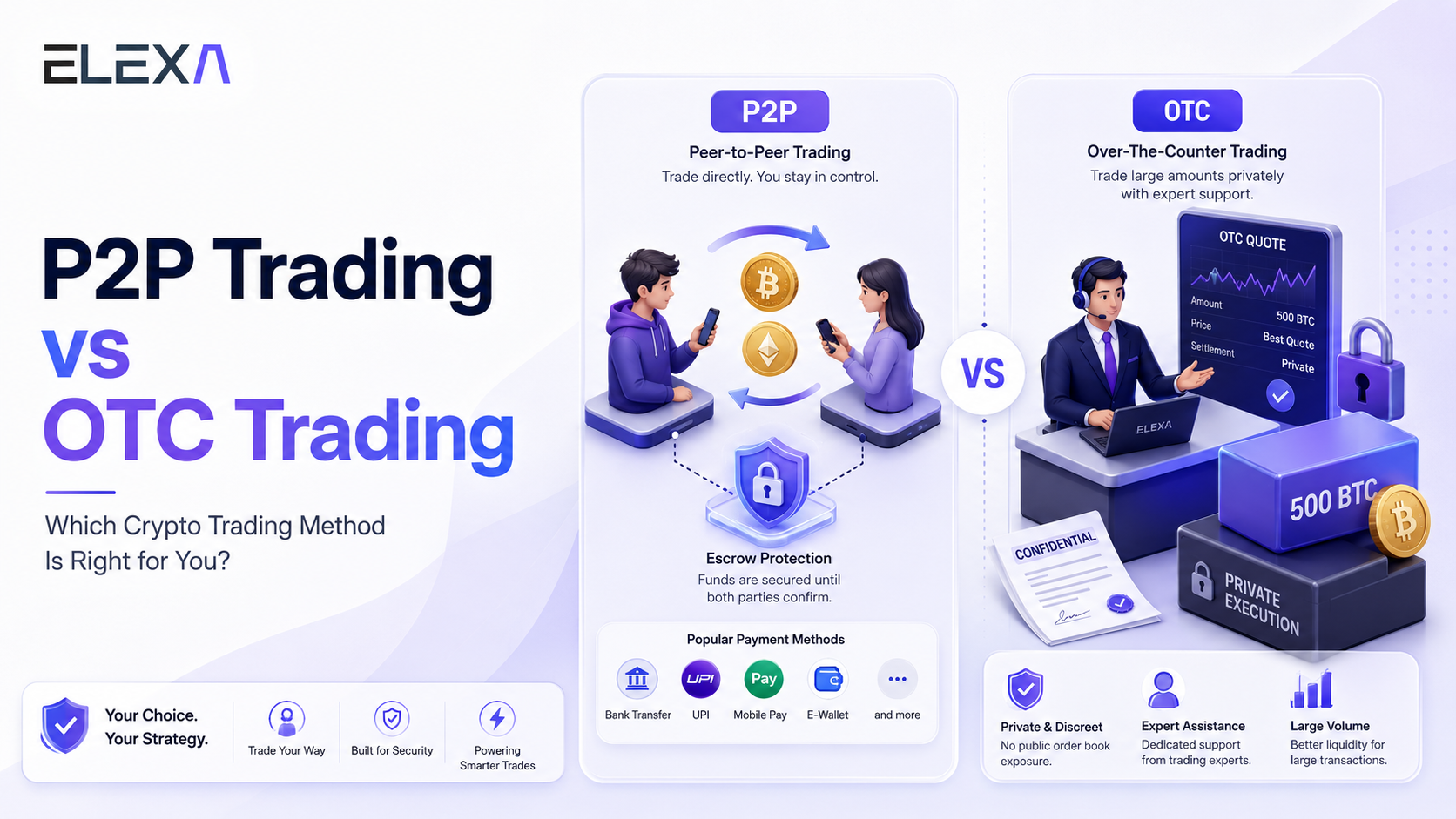
P2P Trading vs OTC Trading: Which Crypto Trading Method Is Right for You?
Answer First
P2P trading and OTC trading are two different ways to buy and sell cryptocurrency outside a standard exchange order book.
P2P trading allows buyers and sellers to trade directly with each other using local payment methods. The platform usually provides escrow protection, trade instructions, user ratings, and dispute support. This model is often useful for individuals, local traders, freelancers, and users who want flexible payment options.
OTC trading, or over-the-counter trading, is usually designed for larger transactions. Instead of trading with many small market participants, a buyer or seller works with a broker, OTC desk, or liquidity provider to complete a large crypto trade privately. OTC trading is often used by institutions, high-volume traders, businesses, and individuals who want to avoid market slippage.
In simple terms:
- P2P trading is better for flexible local currency trades, smaller to medium-sized transactions, and users who want to choose their own payment method.
- OTC trading is better for large-volume trades, private execution, and users who need professional liquidity support.
Both methods can be useful. The right choice depends on your trade size, payment needs, privacy expectations, speed, risk tolerance, and level of trading experience.
---
Introduction
Crypto trading is not limited to centralized exchange order books. Many users buy and sell crypto through alternative trading methods that offer more flexibility, privacy, or local payment access.
Two of the most common options are P2P trading and OTC trading.
At first, they may seem similar because both involve direct trading outside a public exchange order book. But in practice, they serve different users and different purposes.
P2P trading is usually user-to-user. One person wants to buy crypto, another person wants to sell crypto, and the platform helps structure the trade. The buyer may pay with a bank transfer, mobile wallet, cash deposit, or another local payment method. The seller’s crypto may be locked in escrow until payment is confirmed.
OTC trading is usually broker-assisted or desk-assisted. A buyer or seller wants to trade a large amount of crypto and works with an OTC provider to get a quoted price and execute the transaction with less market impact.
For beginners, freelancers, local traders, and users in emerging markets, P2P trading can be more accessible. For high-net-worth individuals, companies, funds, and large-volume traders, OTC trading may be more suitable.
This guide explains the difference between P2P and OTC trading, how each method works, their benefits, risks, common use cases, and how to decide which one is right for you.
---
What Is P2P Trading?
P2P trading, short for peer-to-peer trading, is a method of buying and selling cryptocurrency directly between users.
Instead of buying crypto from the platform itself, users trade with other people. One user creates an offer to sell crypto, and another user accepts that offer. The payment usually happens through a local payment method outside the crypto platform, while the crypto side of the transaction is handled inside the platform.
For example, a seller may create an offer to sell USDT for local currency. A buyer chooses that offer, sends payment through bank transfer, and waits for the seller to confirm the payment. Once the seller confirms that the payment has arrived, the crypto is released to the buyer.
A well-structured P2P marketplace usually includes:
- User-created offers
- Local payment methods
- Escrow protection
- Buyer and seller profiles
- Trade limits
- Trade instructions
- Ratings or completion history
- Dispute resolution
The main idea is simple: users trade directly, but the platform helps make the process safer and more organized.
Platforms such as "Elexa" (https://elexa.io/) use P2P marketplace structures to help buyers and sellers trade crypto with local payment methods while using escrow to reduce counterparty risk.
---
What Is OTC Trading?
OTC trading stands for over-the-counter trading. In crypto, OTC trading usually means buying or selling a large amount of cryptocurrency directly through a broker, OTC desk, liquidity provider, or private trading service.
Instead of placing a large order on a public exchange, the trader requests a quote from an OTC provider. The OTC provider gives a price for the full trade. If the trader accepts the quote, the trade is executed privately.
OTC trading is commonly used for large transactions because placing a large order on a public exchange may move the market price. This is called slippage.
For example, if a trader wants to buy $1 million worth of BTC on a public order book, the available sell orders at the current price may not be enough. As the order fills, the trader may end up buying at increasingly higher prices. An OTC desk can help source liquidity and execute the trade at a negotiated quote.
OTC trading is often used by:
- Institutional investors
- Crypto funds
- High-net-worth individuals
- Businesses
- Market makers
- Miners
- Large-volume traders
- Treasury managers
The main value of OTC trading is execution support for larger trades.
---
How P2P Trading Works
The exact P2P trading flow depends on the platform, but most P2P trades follow a similar process.
1. A Seller Creates an Offer
A seller lists an offer to sell crypto. The offer may include:
- Crypto asset
- Price
- Available amount
- Minimum and maximum order size
- Accepted payment methods
- Payment time limit
- Trade instructions
For example, a seller may offer to sell USDT using bank transfer, mobile money, or another local payment option.
2. A Buyer Chooses the Offer
The buyer compares available offers and chooses one based on price, limits, payment method, seller profile, completion rate, and other trust indicators.
3. Crypto Is Locked in Escrow
Once the trade starts, the seller’s crypto is usually locked in escrow. This means the seller cannot move or sell that crypto elsewhere while the trade is active.
Escrow protects the buyer by making sure the crypto is reserved before payment is sent.
4. The Buyer Sends Payment
The buyer sends local currency payment using the agreed payment method. This may happen through a bank, mobile wallet, payment app, or other local transfer system.
5. The Seller Confirms Payment
The seller checks their account and confirms whether the payment has actually arrived.
The seller should never release crypto based only on a screenshot or payment receipt. Fake payment receipts are one of the most common risks in P2P trading.
6. Crypto Is Released
After the seller confirms payment, the escrow releases the crypto to the buyer.
If there is a disagreement, the platform may provide a dispute process where both sides can submit evidence.
---
How OTC Trading Works
OTC trading is usually more private and more manual than P2P trading.
1. The Trader Contacts an OTC Desk
A buyer or seller contacts an OTC provider and shares their trade requirement.
For example:
- “I want to buy 500,000 USDT worth of BTC.”
- “I want to sell 1 million USDT for USD.”
- “I need to convert a large amount of ETH without moving the market.”
2. The OTC Provider Gives a Quote
The OTC provider checks available liquidity and gives a price quote. This quote may be valid for a short period because crypto prices move quickly.
The quote may include:
- Asset pair
- Trade size
- Price
- Fees or spread
- Settlement terms
- Payment method
- Time limit
3. The Trader Accepts or Rejects the Quote
If the trader accepts the quote, the OTC desk proceeds with execution. If not, the trader can request a new quote or look for another provider.
4. Settlement Happens
Settlement may involve fiat payment, crypto transfer, or both. Depending on the provider, this may require compliance checks, account verification, legal documentation, or banking coordination.
5. The Trade Is Completed Privately
Unlike a public exchange order, the trade is usually not visible on an order book. This is one reason OTC trading is preferred for large transactions.
---
Key Difference Between P2P and OTC Trading
The biggest difference is the type of counterparty and trade size.
In P2P trading, you usually trade directly with another individual or merchant through a marketplace. In OTC trading, you usually trade through a broker, desk, or professional liquidity provider.
P2P trading is marketplace-driven. OTC trading is relationship-driven or service-driven.
Here is the simplest comparison:
Factor| P2P Trading| OTC Trading
Best for| Small to medium trades| Large-volume trades
Counterparty| Individual users or merchants| Broker, desk, or liquidity provider
Payment methods| Often local and flexible| Usually bank or institutional settlement
Price discovery| User-created offers| Quoted by OTC desk
Main protection| Escrow and dispute process| Professional execution and settlement process
Accessibility| Easier for everyday users| Often requires higher trade size
Speed| Depends on buyer/seller response| Depends on quote and settlement
Privacy| Moderate| Higher
Main risk| Counterparty behavior and payment fraud| Provider risk, pricing, settlement terms
Both methods solve different problems.
---
Benefits of P2P Trading
P2P trading is popular because it gives users flexibility that may not be available through traditional exchange methods.
1. Local Payment Methods
One of the biggest benefits of P2P trading is access to local payment methods.
Users may buy or sell crypto using:
- Bank transfer
- Mobile money
- Payment apps
- Cash deposit
- Local wallets
- Regional payment services
This is especially useful in countries where card payments, international banking, or direct exchange deposits are limited.
2. Local Currency Access
P2P trading allows users to buy and sell crypto with local currencies. This is useful for people who want to move between crypto and their everyday money.
For example, a user may want to sell crypto for local currency to pay bills, or buy crypto using money from a local bank account.
3. Flexible Offers
In P2P trading, users can choose from different offers. Sellers may set their own prices, limits, and payment methods.
This gives buyers more choice and gives sellers more control.
4. Escrow Protection
A good P2P marketplace uses escrow to lock crypto during the trade. This helps protect buyers from paying without receiving crypto and helps sellers confirm payment before release.
Escrow does not remove every risk, but it creates a safer structure for direct trading.
5. Easier Access for Beginners
P2P trading can be easier for users who are already familiar with local payment methods but new to crypto exchanges.
Instead of learning complex order books, users can select an offer, follow payment instructions, and complete the trade step by step.
6. Useful for Emerging Markets
In many emerging markets, users need crypto access but may not have smooth access to global exchange payment rails. P2P trading helps bridge that gap by connecting crypto with local payment systems.
---
Benefits of OTC Trading
OTC trading is designed for a different type of user.
1. Better for Large Trades
The biggest benefit of OTC trading is large-volume execution.
If you want to buy or sell a large amount of crypto, an OTC desk may help you avoid slippage and execute the trade more smoothly.
2. Private Execution
OTC trades do not appear directly as public order book activity. This can be useful for large traders who do not want to signal their buying or selling intentions to the market.
3. Professional Support
OTC desks may provide dedicated support, execution advice, settlement coordination, and market insight.
This can be valuable for businesses and institutions.
4. Reduced Market Impact
Large exchange orders can move prices. OTC trading can reduce visible market impact by sourcing liquidity privately.
5. Customized Settlement
OTC providers may support customized settlement terms depending on the trader’s needs, jurisdiction, asset type, and payment method.
---
Risks of P2P Trading
P2P trading is useful, but it has risks.
1. Fake Payment Receipts
A buyer may send a fake screenshot and pressure the seller to release crypto. Sellers should always verify payment directly from their own bank or payment account.
2. Payment Reversals
Some payment methods may allow chargebacks or reversals. Sellers should understand the risks of each payment method before accepting it.
3. Third-Party Payments
A buyer may send payment from someone else’s account. This can create fraud, compliance, or ownership issues.
4. Off-Platform Scams
Scammers may ask users to continue the trade outside the platform. This is dangerous because escrow and dispute protection may no longer apply.
5. Slow Counterparties
P2P trades depend on user response. If the buyer or seller is slow, the trade may take longer than expected.
6. Dispute Complexity
If payment evidence is unclear, disputes can take time. Users should keep accurate proof of payment and follow platform instructions carefully.
---
Risks of OTC Trading
OTC trading also has risks, especially for users who do not understand the process.
1. Counterparty Risk
You must trust the OTC provider or broker. If the provider is unreliable, settlement may become risky.
2. Pricing Risk
OTC quotes may include spread or fees. Traders should understand the full cost before accepting a quote.
3. Minimum Trade Size
Many OTC desks have high minimum trade amounts. This makes OTC unsuitable for small users.
4. Settlement Risk
Large trades often involve complex settlement. Delays in fiat payment, bank processing, or crypto transfer can create risk.
5. Compliance Requirements
OTC providers may require identity verification, source-of-funds checks, business documents, or other compliance steps.
6. Less Transparency
Because OTC trades are private, pricing may be less transparent than public exchange markets. Traders should compare quotes when possible.
---
When P2P Trading Makes More Sense
P2P trading may be the better choice if:
- You want to buy or sell crypto with local currency.
- You need local payment methods.
- Your trade size is small or medium.
- You want to choose from user-created offers.
- You are trading in an emerging market.
- You want escrow protection.
- You prefer marketplace-based trading.
- You want flexibility in payment options.
For example, if you want to buy crypto using a local bank transfer, P2P trading may be more practical than OTC.
P2P is also useful for users who trade frequently in smaller amounts, such as freelancers, local merchants, or individuals who need to convert between crypto and local money.
---
When OTC Trading Makes More Sense
OTC trading may be the better choice if:
- You are trading a large amount.
- You want private execution.
- You want to avoid market slippage.
- You need professional liquidity support.
- You are a business or institution.
- You need customized settlement terms.
- You can meet minimum trade requirements.
- You are comfortable with verification and documentation.
For example, if a company wants to buy a large amount of BTC or sell a large amount of USDT without moving the public market, OTC trading may be more suitable.
---
P2P vs OTC for Local Currency Trading
For local currency trading, P2P is often more accessible than OTC.
P2P marketplaces are usually designed around local payment methods. Sellers can list offers based on the payment methods available in their country. Buyers can choose offers that match their local banking or payment app options.
OTC trading may support fiat settlement, but it is often more formal, larger in size, and less flexible for everyday local payment methods.
If your goal is to buy or sell crypto using local currency in smaller or medium amounts, P2P trading is usually the more practical option.
---
P2P vs OTC for USDT Trading
USDT is commonly used in both P2P and OTC trading, but the use cases are different.
In P2P trading, users often buy or sell USDT to move between crypto and local currency. For example, a user may sell USDT for local money or buy USDT using a bank transfer.
In OTC trading, USDT is often used for large settlements, treasury transfers, or institutional crypto liquidity.
For everyday users, P2P USDT trading is usually more accessible. For large-volume traders, OTC USDT trading may be more efficient.
---
Which Method Is Safer?
Neither method is automatically safer in every situation.
P2P trading can be safe when the platform provides escrow, clear rules, reliable dispute support, and strong user safety practices. But users must still avoid fake receipts, off-platform trades, and risky payment methods.
OTC trading can be safe when the provider is reputable, the quote is clear, and settlement is handled professionally. But users must still evaluate counterparty risk, pricing, and compliance requirements.
The safer method depends on:
- Trade size
- Counterparty quality
- Platform or provider reputation
- Payment method
- Documentation
- User behavior
- Dispute or settlement process
For beginners and local currency users, escrow-based P2P trading may feel more accessible. For large traders, a reputable OTC desk may provide better execution safety.
---
Common Mistakes When Choosing Between P2P and OTC
Mistake 1: Using OTC for Small Trades
If your trade size is small, OTC may be unnecessary. P2P or standard exchange trading may be simpler.
Mistake 2: Using P2P for Very Large Trades Without Planning
Large P2P trades can be risky if payment verification, counterparty trust, and dispute evidence are not handled carefully.
Mistake 3: Ignoring Fees and Spreads
Both P2P and OTC can include hidden costs. P2P prices may include seller premiums. OTC quotes may include spread. Always compare the final rate.
Mistake 4: Choosing Only the Cheapest Price
In P2P trading, the cheapest offer is not always the safest. Seller reputation, payment method, and completion history matter.
Mistake 5: Trusting Screenshots
For P2P sellers, screenshots are not proof of payment. Always verify funds directly.
Mistake 6: Ignoring Settlement Terms
For OTC trades, settlement terms are critical. Know when payment happens, when crypto transfers, and what happens if there is a delay.
Mistake 7: Trading Outside Protection
P2P users should avoid off-platform trades. OTC users should avoid unknown brokers without clear settlement procedures.
---
Practical Decision Guide
Choose P2P trading if you want:
- Local payment methods
- Local currency access
- Smaller or medium trade sizes
- User-created offers
- Escrow protection
- Flexible buyer and seller options
- A marketplace-style experience
Choose OTC trading if you want:
- Large-volume execution
- Private settlement
- Reduced slippage
- Professional trading support
- Customized pricing
- Institutional-level liquidity
In many cases, users may use both methods at different stages. A beginner may start with P2P trading. A business or high-volume trader may later use OTC for larger transactions.
---
FAQ
What is the main difference between P2P and OTC trading?
P2P trading connects individual buyers and sellers through a marketplace. OTC trading usually connects a large buyer or seller with a broker, OTC desk, or liquidity provider.
Is P2P trading better than OTC trading?
P2P trading is better for local payment methods, smaller trades, and everyday users. OTC trading is better for large-volume trades and private execution.
Is OTC trading only for institutions?
Not always, but OTC trading is usually designed for larger traders. Many OTC desks have minimum trade sizes, so it may not be suitable for beginners.
Is P2P trading safe?
P2P trading can be safer when the platform uses escrow and users follow safe trading pr
