
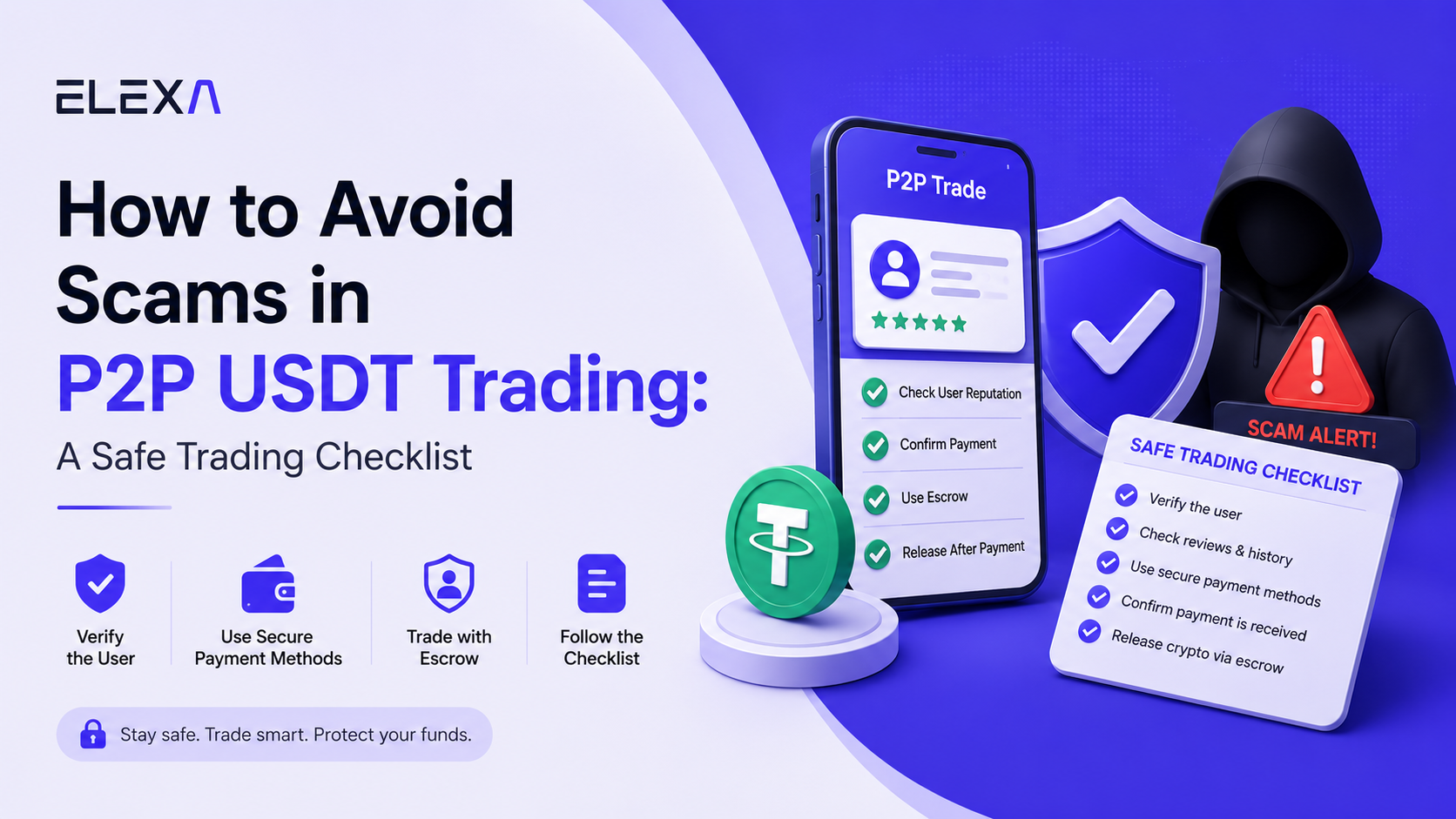
How to Avoid Scams in P2P USDT Trading: A Safe Trading Checklist
P2P USDT trading is one of the most flexible ways to buy and sell cryptocurrency with local money. Instead of trading directly with a centralized exchange, users trade with each other through a peer-to-peer marketplace, choose their preferred payment method, and complete the transaction based on agreed terms.
This flexibility is useful, but it also creates risk.
Fake payment receipts, rushed buyers, third-party bank accounts, payment disputes, impersonation attempts, and off-platform deals are some of the most common problems traders face in P2P crypto markets.
The good news is that most P2P trading scams can be avoided by following a clear safety process.
In this guide, you’ll learn how P2P USDT trading works, the most common scam methods, how escrow protection helps, and the practical checklist every buyer and seller should follow before completing a trade.
If you are looking for a more structured way to trade crypto directly with other users, platforms such as Elexa help organize P2P transactions through offers, payment methods, and escrow-based trading flows.
What Is P2P USDT Trading?
P2P stands for peer-to-peer.
In P2P USDT trading, one user buys USDT directly from another user, usually by paying with local currency through a supported payment method. Instead of placing an order against an exchange order book, buyers and sellers interact through a marketplace where they can choose prices, payment options, and trade conditions.
A typical P2P USDT trade works like this:
- A seller creates an offer to sell USDT.
- A buyer accepts the offer.
- The buyer sends payment using the agreed payment method.
- The seller checks and confirms the payment.
- The USDT is released to the buyer.
Many modern P2P platforms use escrow protection to make this process safer. Understanding how escrow works is one of the most important concepts for anyone new to peer-to-peer crypto trading.
Why P2P USDT Trading Is Popular
P2P trading has grown because it gives users more flexibility than many traditional exchange flows.
Some of the main benefits include:
- Access to local payment methods
- Ability to trade directly with other users
- More control over pricing
- Support for different currencies and payment options
- Flexibility for buyers and sellers in different markets
- A more user-driven trading experience
For many users, P2P marketplaces make crypto more accessible, especially in regions where direct exchange access, banking options, or payment rails may be limited.
However, flexibility should never come at the cost of safety. Because users are trading with other people, it is important to understand the risks before sending money or releasing crypto.
The Golden Rule of P2P Trading
Never release USDT until you have personally confirmed the payment inside your own bank account or payment app.
This is the most important rule in P2P trading.
Do not rely only on:
- Payment screenshots
- Messages from the buyer
- Bank notification screenshots
- Claims that the payment is “pending”
- Pressure from the other trader
- A promise that the payment will arrive soon
A screenshot is not proof of payment.
A message saying “I paid” is not proof of payment.
The only reliable confirmation is seeing the correct amount inside your own account and making sure the payment matches the trade terms.
If you are selling USDT, you should only release the crypto after confirming that the payment has actually arrived.
Common P2P USDT Trading Scams
Most P2P scams are based on speed, confusion, or misplaced trust. Scammers often try to make traders act quickly before checking the details.
Here are the most common risks to watch for.
Fake Payment Receipts
Fake receipts are one of the most common P2P trading scams.
In this scam, the buyer sends a screenshot that looks like a successful bank transfer or payment confirmation. The screenshot may look real, but the money has not actually arrived.
The scammer then pressures the seller to release USDT quickly.
To avoid this:
- Never release USDT based on a screenshot.
- Open your own bank account or payment app.
- Check whether the money has actually arrived.
- Verify the amount.
- Confirm that the sender details match the trade terms.
If the payment is not visible in your own account, do not release the crypto.
Early Release Pressure
Some scammers try to create urgency.
They may say:
- “I already paid, release now.”
- “I am in a hurry.”
- “My bank is slow.”
- “The money will arrive soon.”
- “Trust me, I trade every day.”
- “If you do not release now, I will report you.”
Pressure is a red flag.
A legitimate trader understands that payment verification takes time. You should never release USDT because the other person is impatient.
In P2P trading, verification comes before speed.
Third-Party Payments
A third-party payment happens when the payment comes from someone other than the buyer.
For example, the buyer’s profile may show one name, but the bank payment comes from a different person’s account.
This can create security, compliance, and dispute risks.
To reduce risk:
- Follow the platform’s payment rules.
- Check whether the payment name matches the expected account.
- Avoid accepting suspicious third-party payments.
- Do not ignore mismatched sender details.
If something does not match, pause the trade and use the platform’s dispute or support process.
Off-Platform Trading
Another common risk is when the other user asks you to continue the trade outside the platform.
They may ask you to move to:
- Telegram
- Direct bank coordination
- Private chat outside the marketplace
This is dangerous because it removes important protections.
When you move outside the platform, you may lose:
- Trade history
- Chat records
- Escrow protection
- Dispute support
- Clear evidence of the agreement
- Platform-level safety checks
If a trader asks you to complete the deal outside the platform, treat it as a serious warning sign.
A dedicated P2P marketplace gives both sides a structured environment for the trade. This is one reason why informal crypto deals through social media or messaging apps are usually riskier than platform-based P2P trading.
Impersonation Scams
Fraudsters may pretend to be platform support, an admin, or a trusted trader.
They may contact you and say:
- “Support has approved this trade.”
- “You must release the USDT now.”
- “Send funds to this address.”
- “Your account will be blocked if you do not act.”
Legitimate support teams do not ask you to release crypto before payment confirmation.
They also do not ask you to send funds outside the platform.
Always use official support channels and never trust private messages claiming to be support.
Incorrect Payment Amounts
Sometimes the buyer sends less than the agreed amount, either by mistake or intentionally.
For example, the trade may be for 1,000 USDT, but the fiat payment received is lower than the required amount.
Before releasing USDT, always check:
- The exact trade amount
- The fiat amount received
- Fees or deductions
- Sender details
- Payment method
- Trade terms
If the amount is wrong, do not release the crypto until the issue is resolved.
How Escrow Helps Protect P2P Trades
Escrow is one of the most important safety features in P2P crypto trading.
In an escrow-based trade, the seller’s crypto is temporarily locked when the trade begins. This shows that the seller has committed the crypto to the transaction.
The buyer then sends payment using the agreed method.
After the seller confirms that the payment has actually arrived, the crypto is released to the buyer.
Escrow helps both sides:
- Buyers know the seller cannot easily disappear with the crypto during the trade.
- Sellers have a structured process for confirming payment before release.
- The platform can use the trade record if a dispute occurs.
- Both parties have clearer expectations.
However, escrow does not replace careful payment verification.
Escrow protects the crypto side of the trade. The seller must still verify the fiat payment before releasing USDT.
If you want to learn more about this topic later, a dedicated guide such as “How Escrow Works in P2P Trading” can be useful as part of your P2P safety knowledge.
Before You Start a P2P Trade
A safe trade starts before the payment begins.
Do not accept an offer only because the price looks attractive. A slightly better price is not worth a high-risk trade.
Before starting, review the following points.
Check the Trader’s Reputation
Most P2P marketplaces show some form of trader profile or reputation data.
Before trading, check:
- Number of completed trades
- Positive feedback
- Account age
- Trade completion rate
- Average response time
- Any suspicious behavior in the offer terms
A strong profile does not guarantee safety, but it gives useful context.
If the trader has no history, unclear terms, or suspicious instructions, start small or choose another offer.
Read the Offer Terms Carefully
Many P2P disputes happen because users do not read the offer terms.
Before accepting a trade, check:
- Minimum and maximum trade amount
- Accepted payment method
- Payment time limit
- Required sender account details
- Special instructions
- Fees or deductions
- Conditions for release
If the terms are confusing, aggressive, or unusual, avoid the trade.
Clear offer terms are a sign of a more reliable trading process.
Start With a Smaller Amount
If you are new to P2P trading or trading with a new counterparty, start with a smaller amount.
This helps you understand:
- How the platform works
- How the payment flow works
- How responsive the other trader is
- How disputes or delays are handled
- Whether the payment method is reliable
After gaining experience, you can gradually increase your trade size.
Keep Communication Inside the Platform
All trade communication should stay inside the platform.
This helps protect both sides because the platform can review the conversation if a dispute happens.
Avoid sharing sensitive personal information outside the platform.
Do not continue the trade through private messaging apps.
Do not agree to hidden terms outside the trade page.
If the other user insists on moving outside the platform, consider canceling or reporting the trade.
During the Trade: How to Stay Safe
Once the trade starts, slow down and verify every detail.
Scammers often rely on users rushing through the process.
Confirm the Trade Details
Before sending or accepting payment, double-check:
- Asset: USDT
- Amount of USDT
- Fiat amount
- Payment method
- Payment account details
- Payment time limit
- Offer terms
- Buyer or seller profile
If anything does not match, do not continue until it is clear.
Use Only the Agreed Payment Method
Do not switch payment methods during the trade unless the platform allows it and both sides clearly agree inside the trade page.
For example, if the offer says bank transfer, do not accept a different payment method in a private chat.
Changing the payment method can make disputes harder to resolve.
It can also create unclear evidence if something goes wrong.
Never Trust Screenshots Alone
Screenshots can be edited.
Receipts can be fake.
Notifications can be misleading.
Even a real screenshot may not prove that money is final and available.
If you are selling USDT, log in to your own bank account or payment app and confirm:
- The money arrived
- The amount is correct
- The payment is not pending
- The sender details are acceptable
- The payment matches the trade
Only after this should you release the USDT.
Watch for Pressure Tactics
A common scam pattern is urgency.
The other trader may try to make you feel guilty, afraid, or rushed.
Examples include:
- “I sent the money. Why are you waiting?”
- “Release now or I will complain.”
- “You are wasting my time.”
- “My bank always delays confirmation.”
- “I need the USDT urgently.”
Do not argue. Do not rush.
Simply verify the payment. If it is not confirmed, do not release the crypto.
Red Flags You Should Never Ignore
Stop and review the trade carefully if you notice any of these warning signs:
- The user asks to continue outside the platform.
- The user sends only a screenshot as proof.
- The money does not appear in your account.
- The payment amount is incorrect.
- The sender name does not match the expected account.
- The user changes payment details after the trade starts.
- The user pressures you to release quickly.
- The user claims to be support.
- The user offers an unusually high price.
- The user becomes aggressive or threatening.
- The user asks you to cancel after payment.
When in doubt, do not release funds.
Use the platform’s dispute or support process.
Seller Safety Checklist
If you are selling USDT, use this checklist before releasing crypto.
Before release, confirm:
- The payment has arrived in your own account.
- The amount is exactly correct.
- The payment is not pending.
- The sender details match the trade requirements.
- The payment method matches the offer.
- The buyer did not ask to move outside the platform.
- The buyer did not pressure you to release early.
- The trade chat and payment records are available.
- There are no suspicious changes in the trade.
If any item is unclear, do not release the USDT yet.
Buyer Safety Checklist
If you are buying USDT, you also need to protect yourself.
Before sending payment, check:
- The seller’s profile
- The seller’s completed trade history
- The offer price
- The minimum and maximum trade limits
- The payment instructions
- The payment account details
- Whether escrow is active
- The trade time limit
- The platform’s rules
After sending payment:
- Mark the payment as completed only after actually paying.
- Keep your payment record.
- Stay available in the trade chat.
- Do not ask the seller to release before payment confirmation.
- Do not move the conversation outside the platform.
A clean and transparent payment process helps both sides complete the trade safely.
What to Do If Something Goes Wrong
Even careful traders can face disputes.
If something goes wrong, stay calm and keep records.
Do not delete messages.
Do not cancel the trade unless you are sure it is safe.
Do not release USDT if payment is not confirmed.
Instead:
- Keep the trade open.
- Save relevant screenshots.
- Record payment details.
- Keep all communication inside the platform.
- Explain the issue clearly.
- Open a dispute if available.
- Provide evidence.
Useful evidence includes:
- Trade ID
- Payment receipt
- Bank or payment app transaction details
- Chat messages
- Timestamps
- Sender and receiver information
- Screenshots from your actual account activity
The clearer your evidence is, the easier it is to review the issue.
Why Structured P2P Platforms Are Safer Than Informal Deals
Many people start crypto trading through informal groups, private chats, or social media.
While that may seem fast, it can be risky.
Informal deals often lack:
- Escrow protection
- Trade records
- Reputation systems
- Dispute resolution
- Structured payment flow
- Clear offer terms
- Platform-level safety checks
A dedicated P2P marketplace provides a more organized trading environment.
Platforms like Elexa are designed to help users trade crypto directly with other people while reducing many of the risks associated with informal peer-to-peer transactions.
For users who want more control over price and trade conditions, creating an offer can also be a useful way to define terms clearly. On Elexa, users can create an offer and choose how they want to buy or sell crypto with local money.
Safe P2P USDT Trading Checklist
Use this checklist before every P2P USDT trade.
| Stage | Safety Check |
|---|---|
| Before trade | Check the trader’s reputation |
| Before trade | Read the offer terms |
| Before trade | Confirm the payment method |
| Before trade | Start with a reasonable amount |
| During trade | Keep communication inside the platform |
| During trade | Use only the agreed payment method |
| During trade | Do not trust screenshots alone |
| During trade | Verify payment in your own account |
| During trade | Never release USDT under pressure |
| After trade | Save important records |
| After trade | Leave honest feedback if available |
| If a problem happens | Open a dispute and provide evidence |
Frequently Asked Questions
Is P2P USDT trading safe?
P2P USDT trading can be safer when users follow a clear process, use escrow protection, verify payments carefully, and avoid off-platform deals. The biggest risks usually come from rushing, trusting screenshots, or ignoring suspicious behavior.
Should I release USDT after receiving a payment screenshot?
No. A screenshot is not enough. You should only release USDT after confirming the payment inside your own bank account or payment app.
What is the most common P2P trading scam?
One common scam is the fake payment receipt. The buyer sends a screenshot that appears to show a successful payment, but the money has not actually arrived. Always verify the payment directly in your own account.
Is it safe to trade outside the platform?
Trading outside the platform is risky. You may lose access to escrow protection, trade history, dispute support, and clear evidence of the agreement.
What should I do if the buyer pressures me to release USDT?
Do not release under pressure. Verify the payment first. If the buyer becomes aggressive or suspicious, keep the trade open and use the platform’s dispute process if available.
Can escrow prevent every scam?
No. Escrow helps protect the crypto side of the trade, but sellers must still verify that fiat payment has actually arrived before releasing USDT.
Final Thoughts
P2P USDT trading gives users flexibility, access to local payment methods, and more control over how they buy and sell crypto.
But safety depends on discipline.
The safest traders follow a process:
- They check the trader’s profile.
- They read the offer terms.
- They stay inside the platform.
- They verify payment themselves.
- They use escrow protection.
- They never release crypto under pressure.
If you follow these principles, you can reduce risk and trade with more confidence.
P2P trading is not about moving fast. It is about verifying carefully, following the process, and protecting your funds.
If you are ready to trade crypto directly with other users, you can explore the marketplace on Elexa and use this checklist before every trade.
