
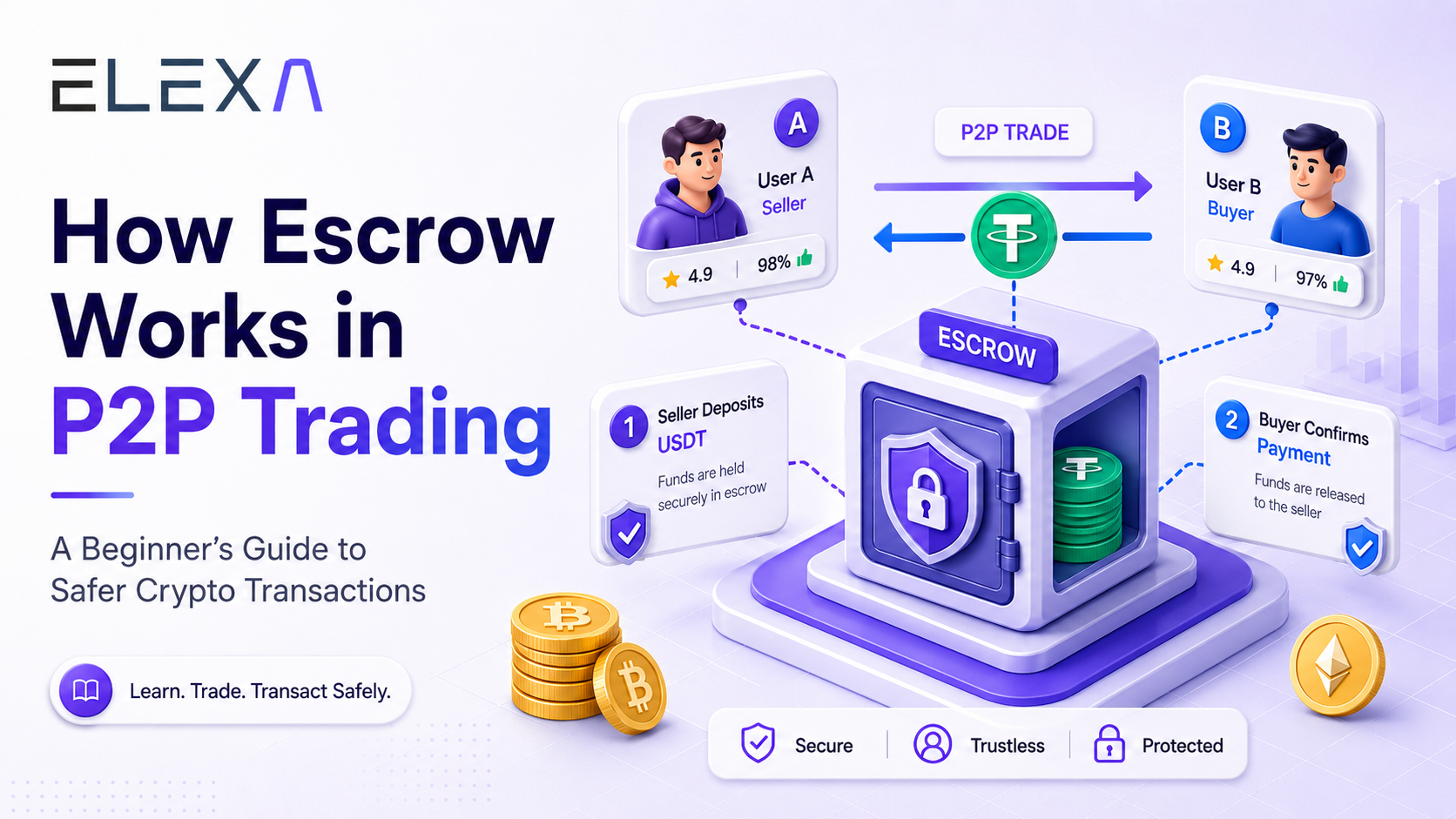
How Escrow Works in P2P Trading: A Beginner’s Guide to Safer Crypto Transactions
Answer First
Escrow in P2P trading is a safety mechanism that temporarily holds cryptocurrency during a transaction between a buyer and a seller. Instead of sending crypto directly to the buyer before payment is confirmed, the platform locks the seller’s crypto in escrow. Once the buyer completes the agreed payment and the seller confirms receipt, the escrow releases the crypto to the buyer.
This process helps reduce counterparty risk, prevents sellers from disappearing after receiving payment, and protects buyers from paying without receiving crypto. Escrow does not remove every risk in P2P trading, but it creates a structured process that makes peer-to-peer crypto transactions safer, clearer, and easier to manage.
In simple terms:
- The seller creates or accepts a trade.
- The crypto is locked in escrow.
- The buyer sends payment using the agreed method.
- The seller confirms the payment.
- The crypto is released to the buyer.
Platforms such as Elexa use escrow mechanisms to help structure P2P transactions and reduce the risk of direct peer-to-peer trading.
Introduction
Peer-to-peer crypto trading gives users more flexibility than many traditional exchange models. Instead of buying or selling crypto directly from a centralized exchange order book, users trade with each other. One person wants to buy crypto using local currency, while another person wants to sell crypto and receive payment through a bank transfer, mobile payment app, or another supported payment method.
This flexibility is one of the biggest strengths of P2P trading. It allows users to trade with local currencies, choose from different payment methods, compare offers, and negotiate within marketplace rules. For users in markets where card payments or direct exchange access may be limited, P2P trading can be especially useful.
But direct trading between two people also creates an obvious problem: trust.
If the buyer pays first, how can they be sure the seller will send the crypto?
If the seller sends crypto first, how can they be sure the buyer will pay?
This is exactly where escrow becomes important.
Escrow acts as a neutral holding mechanism. It gives both sides a safer way to complete a transaction without requiring blind trust. The buyer does not have to rely only on the seller’s promise, and the seller does not have to release crypto before confirming payment.
In this guide, we will explain how escrow works in P2P trading, why it matters, what risks it helps reduce, what risks still remain, and how beginners can use escrow more safely when buying or selling crypto.
What Is Escrow in P2P Trading?
Escrow is a process where an asset is temporarily held by a neutral third party until the conditions of a transaction are completed.
In P2P crypto trading, the asset held in escrow is usually cryptocurrency. For example, if a seller wants to sell USDT, BTC, ETH, or another supported crypto asset, the platform locks the seller’s crypto once the trade begins. The seller cannot withdraw, move, or cancel that locked crypto freely while the trade is active.
The crypto remains locked until one of the following happens:
- The seller confirms that payment has been received and releases the crypto.
- The trade is cancelled according to platform rules.
- A dispute is opened and resolved by the platform’s support or dispute team.
The main purpose of escrow is to prevent one party from taking the other party’s money or crypto without completing their side of the trade.
Without escrow, a buyer might send money and never receive crypto. A seller might send crypto and never receive payment. Escrow reduces this risk by making sure the crypto is already reserved for the buyer before the buyer makes payment.
This is why escrow is one of the most important features of a P2P crypto marketplace.
How Escrow Works Step by Step
The exact flow can vary slightly from one platform to another, but most P2P escrow systems follow a similar structure.
1. A Seller Creates an Offer
A seller starts by creating an offer to sell crypto. The offer usually includes details such as:
- Crypto asset being sold
- Price
- Minimum and maximum trade amount
- Accepted payment methods
- Payment time limit
- Buyer requirements
- Trade instructions
For example, a seller may create an offer to sell USDT for local currency using bank transfer. The seller defines how much USDT is available, the exchange rate, and which payment method the buyer must use.
This offer then becomes visible to potential buyers in the P2P marketplace.
2. A Buyer Selects the Offer
The buyer reviews available offers and chooses one that matches their needs. A buyer may compare sellers based on:
- Price
- Payment method
- Trade limits
- Completion rate
- Number of previous trades
- User rating
- Payment speed
- Verification level
Choosing the right seller is important. Escrow helps reduce risk, but users should still pay attention to seller history, trade terms, and payment instructions.
Once the buyer selects the offer, they enter the amount they want to buy and start the trade.
3. The Crypto Is Locked in Escrow
After the trade starts, the platform locks the seller’s crypto in escrow. This is the most important step.
The buyer can now see that the crypto has been reserved for the trade. The seller cannot sell the same crypto to another user or move it away while the trade is active.
For example, if the buyer wants to buy 500 USDT, the platform locks 500 USDT from the seller’s available balance. That 500 USDT stays locked until the trade is completed, cancelled, or resolved through dispute.
This gives the buyer more confidence before sending payment.
4. The Buyer Sends Payment
After the crypto is locked, the buyer sends payment using the agreed method.
This may include:
- Bank transfer
- Mobile wallet transfer
- Local payment app
- Cash deposit
- Other supported local payment methods
The buyer must follow the seller’s payment instructions carefully. This includes sending the exact amount, using the correct account details, and avoiding notes or references that violate payment provider rules.
After making the payment, the buyer marks the trade as paid.
This action tells the seller that the payment has been sent and that they should check their account.
5. The Seller Confirms Receipt
The seller checks their payment account to confirm that the money has actually arrived.
This step is critical.
The seller should not release crypto based only on:
- A screenshot
- A payment receipt image
- A buyer’s message
- A pending transaction notice
- A bank notification that does not confirm final settlement
Fake payment receipt scams are common in P2P trading. A buyer may upload a fake screenshot or claim that payment has been sent when it has not arrived. Sellers should always verify payment directly from their bank account, payment app, or official transaction history.
Once the seller confirms that the payment has been received, they approve the trade.
6. The Crypto Is Released to the Buyer
After the seller confirms payment, the escrow releases the crypto to the buyer’s platform wallet.
The trade is now complete.
The buyer receives the crypto, and the seller keeps the local currency payment. Both sides have completed their obligations.
This simple flow is what makes escrow useful: the buyer pays only after the crypto is locked, and the seller releases crypto only after payment is confirmed.
Why Escrow Matters in P2P Crypto Trading
Escrow is important because P2P trading is based on direct interaction between users. Unlike a traditional exchange trade where the platform matches orders automatically and updates balances internally, P2P trading includes an external payment step.
That external payment step creates risk.
A buyer may need to send money outside the crypto platform. A seller may need to wait for local currency to arrive. Payment providers, banks, and mobile apps may have delays, reversals, limits, or verification issues.
Escrow helps manage this uncertainty by creating a controlled process around the crypto side of the transaction.
It Reduces Buyer Risk
From the buyer’s point of view, the biggest fear is paying and not receiving crypto.
Escrow reduces this risk because the seller’s crypto is already locked before payment is made. The seller cannot simply disappear with the buyer’s payment while still keeping control of the crypto.
If the seller refuses to release the crypto after receiving payment, the buyer can usually open a dispute and provide evidence.
It Reduces Seller Risk
From the seller’s point of view, the biggest fear is releasing crypto before actually receiving payment.
Escrow does not force the seller to release crypto automatically when the buyer clicks “paid.” Instead, the seller must confirm that payment has arrived. This gives the seller control over the final release step.
A good escrow process allows the seller to review payment carefully before completing the trade.
It Creates a Clear Trade Timeline
Escrow also creates structure.
Instead of two users casually messaging each other and hoping everything goes well, the platform defines the trade stages:
- Trade started
- Crypto locked
- Payment pending
- Buyer marked as paid
- Seller confirmation pending
- Crypto released
- Trade completed
This timeline makes it easier to track what happened and when. If there is a dispute, the platform can review trade status, messages, timestamps, payment evidence, and user actions.
It Supports Dispute Resolution
Disputes can happen even when both users act honestly.
For example:
- A bank transfer may be delayed.
- The buyer may send the wrong amount.
- The seller may not recognize the payment.
- The buyer may forget to include required details.
- A payment provider may temporarily hold the transaction.
Escrow gives the platform time to review the issue before crypto is released or returned. Without escrow, dispute resolution would be much harder because the crypto may already be gone.
Benefits of Escrow in P2P Trading
Escrow offers several practical benefits for both buyers and sellers.
1. Safer Transactions
The most obvious benefit is safety. Escrow makes it harder for either side to complete only half of the transaction and disappear.
It does not guarantee that every trade will be perfect, but it significantly improves the structure of the transaction.
2. Better Trust Between Strangers
P2P marketplaces often connect people who do not know each other. Without escrow, users would need to trust strangers with money or crypto directly.
Escrow reduces the need for personal trust by replacing it with process-based trust.
The buyer trusts that the crypto is locked. The seller trusts that they can confirm payment before release.
3. Support for Local Currency Payments
Many users choose P2P trading because they want to buy or sell crypto using local currency. Escrow makes these local currency transactions more practical because it separates the crypto transfer from the external payment confirmation process.
This is especially useful in markets where users prefer local banks, mobile wallets, or regional payment apps.
4. More Flexible Payment Methods
Because escrow creates a safer trading structure, P2P marketplaces can support multiple payment methods. Different sellers can accept different payment options, and buyers can choose what works best for them.
This flexibility is one reason P2P trading remains popular across different countries and regions.
5. Better User Confidence
New users are often nervous when trading crypto for the first time. Escrow helps make the process easier to understand.
Instead of sending money into an unclear situation, users can follow a step-by-step process where the crypto is locked, the payment is tracked, and support is available if something goes wrong.
6. Lower Counterparty Risk
Counterparty risk means the risk that the person on the other side of the trade will not complete their part.
Escrow reduces this risk by preventing the seller from keeping full control of the crypto during the trade. It also gives the seller a clear confirmation step before releasing funds.
Risks Escrow Helps Reduce
Escrow is not just a convenience feature. It directly addresses some of the most common risks in P2P trading.
Non-Delivery of Crypto
Without escrow, a seller could receive payment and refuse to send crypto. Escrow reduces this risk because the crypto is already locked before the buyer pays.
Seller Disappearance
A seller may go offline after the buyer sends payment. If crypto is locked in escrow, the buyer can open a dispute and provide payment evidence.
Double Selling
A seller cannot use the same locked crypto for multiple active trades. Once the crypto is in escrow, it is reserved for that specific transaction.
Payment Confusion
Escrow systems usually create a trade page with details such as amount, payment method, time limit, and status. This reduces confusion between buyer and seller.
False Claims
If one party claims that payment was or was not made, the dispute team can review evidence before crypto is released. This gives both sides a structured way to resolve disagreement.
Risks Escrow Does Not Fully Remove
Escrow is powerful, but it is not magic. Users still need to act carefully.
Fake Payment Receipts
A buyer may send a fake receipt or edited screenshot. Sellers should never release crypto based only on a screenshot. They should check the actual payment account.
Reversible Payments
Some payment methods may allow chargebacks, reversals, or disputes after the crypto has already been released. Sellers should understand the payment method they accept and avoid methods with high reversal risk when possible.
Third-Party Payments
A buyer may send payment from someone else’s account. This can create compliance, fraud, and ownership issues. Many platforms discourage or prohibit third-party payments.
As a rule, the payment account name should match the verified name of the buyer whenever possible.
Social Engineering
Scammers may try to pressure users into acting quickly. For example, they may say:
- “Release now, payment will arrive soon.”
- “The bank is slow, but I already paid.”
- “I sent proof, why are you delaying?”
- “Cancel the trade and I will send again.”
- “Continue this trade outside the platform.”
Escrow only works properly when users stay inside the platform’s trade process.
Off-Platform Communication
If users move the trade to another messaging app or agree to complete payment outside the platform’s rules, they may lose protection. Important trade messages should stay inside the platform whenever possible.
User Error
Escrow cannot prevent every mistake. A buyer might send payment to the wrong account. A seller might release crypto too early. A user might ignore trade instructions.
The safest P2P traders combine escrow with careful behavior.
Practical Guide: How to Use Escrow Safely as a Buyer
If you are buying crypto through a P2P marketplace, escrow can protect you, but only if you follow the correct process.
1. Choose Sellers Carefully
Before starting a trade, check the seller’s profile. Look for:
- High completion rate
- Positive feedback
- Reasonable trade history
- Clear payment instructions
- Realistic pricing
- Verification level, if available
A very low price can be attractive, but it may also signal higher risk. Do not choose an offer only because it is the cheapest.
2. Read the Offer Terms
Every P2P offer may have specific conditions. The seller may require payment from an account in your own name, a specific payment reference, or a certain bank.
Read the terms before starting the trade. If you cannot meet the requirements, choose another offer.
3. Confirm That Crypto Is Locked
Do not send payment until the trade is active and the crypto is locked in escrow.
This is one of the most important buyer safety rules.
4. Send the Exact Payment Amount
Send the exact amount shown in the trade. If the amount is wrong, the seller may not be able to confirm payment easily, and the trade may be delayed.
5. Use the Agreed Payment Method
Do not switch payment methods after the trade starts unless the platform allows it and both sides agree within the trade chat.
Changing payment methods can create confusion and may affect dispute handling.
6. Mark as Paid Only After Sending Payment
Do not click “paid” before actually sending the money. This can create unnecessary disputes and may damage your account reputation.
7. Keep Proof of Payment
Keep payment evidence until the trade is complete. Useful evidence may include:
- Bank transaction record
- Payment app confirmation
- Transaction ID
- Sender and receiver account details
- Date and time
- Exact amount
If there is a dispute, clear evidence will help.
8. Never Cancel After Paying
If you have already paid, do not cancel the trade unless support instructs you to do so. Cancelling after payment may release the escrow back to the seller and make the situation harder to resolve.
9. Stay Inside the Platform
Keep trade communication inside the P2P platform. Do not move the deal to private messaging apps, especially if the other party asks you to bypass escrow.
Practical Guide: How to Use Escrow Safely as a Seller
If you are selling crypto, escrow protects the buyer by locking your crypto. But you also need to protect yourself before releasing it.
1. Set Clear Offer Terms
Your offer should clearly explain:
- Accepted payment methods
- Required account name rules
- Payment time limit
- Whether third-party payments are allowed
- Any payment reference requirements
- What buyers should avoid writing in payment notes
Clear terms reduce disputes.
2. Wait for the Buyer to Pay
Once the trade starts, your crypto is locked. Wait until the buyer sends payment and marks the trade as paid.
3. Verify Payment Directly
Always check your bank account, payment app, or official transaction history.
Do not rely only on screenshots, notifications, or messages from the buyer.
4. Check the Sender Name
If possible, confirm that the sender’s account name matches the buyer’s verified name on the platform.
Third-party payments can create risk. If the payment comes from an unexpected account, follow platform rules and consider contacting support before releasing crypto.
5. Confirm the Exact Amount
Make sure the amount received matches the trade amount. If the buyer sends less, do not release the full crypto amount until the issue is resolved.
6. Be Careful With Pending Payments
Some payment systems show pending or processing status before the funds are fully settled. Do not release crypto until the payment is actually available and final.
7. Do Not Release Under Pressure
Scammers often create urgency. They may pressure you to release quickly, send fake proof, or claim that the platform is slow.
Take your time and verify properly.
8. Use Dispute Support When Needed
If something does not look right, open a dispute or contact support according to platform rules. Escrow exists so that unclear situations can be reviewed before crypto is released.
Common Escrow Mistakes in P2P Trading
Even with escrow, users can still make mistakes. Here are some of the most common ones.
Mistake 1: Sending Payment Before Escrow Is Locked
Buyers should never send payment before the trade is active and the crypto is locked. If you pay outside the escrow flow, the platform may not be able to protect you properly.
Mistake 2: Releasing Crypto Based on a Screenshot
Sellers should never release crypto because a buyer sends a screenshot. Screenshots can be edited. Always verify payment from your own account.
Mistake 3: Cancelling a Trade After Paying
If a buyer pays and then cancels the trade, the escrow may be released back to the seller. This can create a serious problem. If you paid and there is an issue, open a dispute instead of cancelling.
Mistake 4: Ignoring Offer Terms
Many disputes happen because one side did not read the trade terms. For example, a seller may require payment from a matching name, but the buyer sends money from another person’s account.
Read before trading.
Mistake 5: Trading Outside the Platform
Some scammers try to move users away from the platform to avoid escrow protection. They may offer a better rate or faster processing. This is risky.
If the trade starts on a P2P platform, keep the trade inside the platform.
Mistake 6: Using Risky Payment Methods Without Understanding Them
Some payment methods are faster but easier to reverse. Others are slower but more final. Sellers should understand the payment methods they accept.
Mistake 7: Not Keeping Evidence
Both buyers and sellers should keep records until the trade is completed. Evidence is especially important if a dispute happens.
Mistake 8: Rushing the Confirmation Step
P2P trading requires patience. A buyer should not rush payment. A seller should not rush release. Escrow helps create a safe process, but users must still follow it carefully.
Escrow and Dispute Resolution
Disputes are an important part of any P2P trading system. Even when most trades go smoothly, there must be a process for handling disagreements.
A dispute may happen when:
- The buyer says they paid, but the seller says they did not receive payment.
- The seller refuses to release crypto.
- The buyer sends the wrong amount.
- The payment comes from a third party.
- The payment is delayed.
- One party violates offer terms.
- There is suspected fraud.
When a dispute is opened, the escrow usually remains locked while the platform reviews the case.
The platform may ask for evidence such as:
- Payment receipt
- Bank statement
- Transaction ID
- Screenshots from official payment apps
- Account holder name
- Trade chat history
- Time and date of payment
The goal is to determine whether the buyer completed the payment correctly and whether the seller should release the crypto.
This is why users should keep communication and evidence inside the platform whenever possible.
A well-structured P2P marketplace gives both sides a clear way to raise issues without immediately losing funds. For example, a P2P Marketplace with escrow and dispute handling can help users avoid the uncertainty of informal direct trades.
Escrow in P2P USDT Trading
Escrow is especially important in P2P USDT trading because USDT is one of the most commonly traded assets in peer-to-peer markets.
Many users choose USDT because it is a stablecoin designed to track the value of the US dollar. This makes it useful for users who want to move between crypto and local currency without taking on as much price volatility as assets like BTC or ETH.
In a typical P2P USDT trade:
- The seller offers USDT for local currency.
- The buyer starts the trade.
- The seller’s USDT is locked in escrow.
- The buyer sends local currency payment.
- The seller confirms receipt.
- The USDT is released to the buyer.
Because USDT is widely used, scammers often target P2P USDT traders with fake receipts, off-platform offers, third-party payments, and social engineering.
Escrow helps reduce these risks, but users still need to follow safe trading habits.
For more detailed safety practices, a related guide such as “How to Avoid Scams in P2P USDT Trading” can be useful as a next step.
Escrow vs Direct Crypto Transfers
Some users wonder why they should use escrow instead of simply sending crypto directly to another person.
Direct crypto transfers are fast, but they are also final. Once crypto is sent on-chain, it usually cannot be reversed. If you send crypto to the wrong person or release it before receiving payment, recovery may be impossible.
Escrow adds a layer of protection before the crypto moves permanently.
Direct Transfer
In a direct transfer:
- The seller sends crypto directly to the buyer’s wallet.
- The buyer sends local currency separately.
- There may be no neutral party.
- There may be no dispute process.
- The risk depends almost entirely on trust.
Escrow-Based P2P Trade
In an escrow-based trade:
- The crypto is locked before payment.
- The seller cannot move the locked crypto during the trade.
- The buyer has proof that crypto is reserved.
- The seller confirms payment before release.
- Dispute support may be available.
For most users, especially beginners, escrow-based P2P trading is safer than informal direct trading.
Escrow vs Centralized Exchange Trading
Escrow is mostly associated with P2P trading. In centralized exchange trading, users typically buy and sell through an order book or instant conversion system. The exchange updates balances internally, and there is usually no external payment step between users.
P2P trading is different because one side pays the other directly using a selected payment method.
This makes escrow necessary.
In centralized exchange trading:
- Trades are matched automatically.
- Payment usually happens within the platform.
- Users do not negotiate directly.
- The exchange controls the trade flow.
In P2P trading:
- Users choose counterparties.
- Payment may happen outside the platform.
- Users may choose local payment methods.
- Escrow protects the crypto during the external payment step.
Neither model is always better. They serve different needs. Centralized exchange trading can be fast and simple. P2P trading can be more flexible, especially for local currency payments and user-created offers.
How to Choose a P2P Platform With Good Escrow
Not all P2P platforms are equal. If escrow is important to you, look for a platform that provides a clear and reliable trading process.
Here are features to consider.
Clear Escrow Status
The platform should clearly show when crypto is locked, when payment is pending, and when release is expected.
Dispute Support
There should be a defined process for opening disputes and submitting evidence.
User Ratings and Trade History
Ratings, completion rates, and trade counts help users evaluate counterparties before trading.
Clear Offer Terms
A good marketplace should allow sellers to explain payment requirements and trade conditions clearly.
Secure Account Practices
Security features such as account verification, login protection, and withdrawal controls can help reduce account-level risks.
Helpful Educational Content
P2P trading requires user awareness. Platforms that provide educational guides, scam warnings, and trading checklists can help users make better decisions.
Offer Creation Tools
For sellers and active traders, the ability to Create an Offer is important. A clear offer creation flow helps sellers define price, limits, payment methods, and trade conditions in a structured way.
Best Practices for Safer Escrow-Based Trading
Escrow works best when users follow good trading habits.
For Buyers
- Do not pay before crypto is locked.
- Read the offer terms.
- Use the agreed payment method.
- Send the exact amount.
- Keep proof of payment.
- Do not cancel after paying.
- Avoid off-platform communication.
- Open a dispute if the seller does not release crypto after valid payment.
For Sellers
- Write clear offer terms.
- Verify payment directly.
- Do not trust screenshots alone.
- Check sender name and amount.
- Avoid third-party payments if platform rules discourage them.
- Do not release crypto while payment is pending.
- Use dispute support if something seems suspicious.
For Both Sides
- Stay calm during delays.
- Keep communication professional.
- Follow platform instructions.
- Avoid rushing.
- Do not accept unusual requests.
- Do not move the trade outside escrow.
Escrow is a safety structure, but careful behavior is still the user’s responsibility.
FAQ
What does escrow mean in P2P trading?
Escrow means the seller’s crypto is temporarily locked by the platform during a P2P trade. The crypto is released to the buyer only after the seller confirms that payment has been received.
Is escrow safe for buying USDT?
Escrow makes buying USDT through P2P trading safer because the seller’s USDT is locked before the buyer sends payment. However, buyers should still follow platform rules, use the agreed payment method, and keep proof of payment.
Can a seller cancel after I pay?
If you have already paid, you should not cancel the trade yourself. If the seller does not release crypto, open a dispute and provide payment evidence. The exact process depends on the platform’s rules.
Can a buyer fake payment in escrow trading?
Yes, a buyer can attempt to send a fake receipt or screenshot. This is why sellers should always confirm payment directly from their own bank account or payment app before releasing crypto.
Does escrow protect sellers?
Yes, escrow can protect sellers by allowing them to confirm payment before releasing crypto. However, sellers must be careful with fake receipts, pending payments, third-party payments, and reversible payment methods.
What happens if there is a dispute?
If there is a dispute, the crypto usually remains locked while the platform reviews evidence from both sides. The platform may ask for payment proof, transaction records, account details, and chat history.
Is escrow the same as a smart contract?
Not always. Some escrow systems may use smart contracts, but many P2P marketplaces use platform-controlled escrow. The basic idea is the same: crypto is held until trade conditions are met.
Should beginners use escrow for P2P trading?
Yes. Beginners should avoid informal direct trades and use a P2P marketplace with escrow, clear trade instructions, and dispute support.
Can escrow prevent all scams?
No. Escrow reduces many risks, but it cannot prevent every scam. Users still need to verify payments, avoid off-platform trades, and follow safe trading practices.
Why is escrow important for local currency crypto trading?
Local currency payments often happen outside the crypto platform through banks or payment apps. Escrow helps protect the crypto side of the transaction while the local currency payment is completed and verified.
Conclusion
Escrow is one of the most important safety mechanisms in P2P crypto trading. It helps buyers and sellers trade with more confidence by locking the seller’s crypto until payment is confirmed.
For buyers, escrow reduces the risk of paying without receiving crypto. For sellers, it creates a structured process where crypto is released only after payment is verified. For both sides, escrow provides a clearer trade timeline and a better foundation for dispute resolution.
However, escrow is not a complete replacement for caution. Users still need to choose counterparties carefully, read offer terms, verify payment directly, avoid fake receipts, stay inside the platform, and keep evidence until the trade is complete.
P2P trading can be flexible and useful, especially for users who want to buy or sell crypto with local currency. Escrow makes that process safer by replacing blind trust with a structured transaction flow.
If you are new to P2P trading, start slowly, use escrow-based trades, follow the instructions carefully, and learn the most common scam patterns before increasing your trade size.
A safer P2P trade is not only about finding the best price. It is about using the right process, choosing the right counterparty, and making sure every step is confirmed before moving forward.
Soft CTA
If you are ready to explore P2P crypto trading, you can start by comparing offers, reviewing payment methods, and learning how escrow protects each transaction. When you understand the process, you can also create your own trading terms and Create Your First Offer on a P2P marketplace such as Elexa.
