
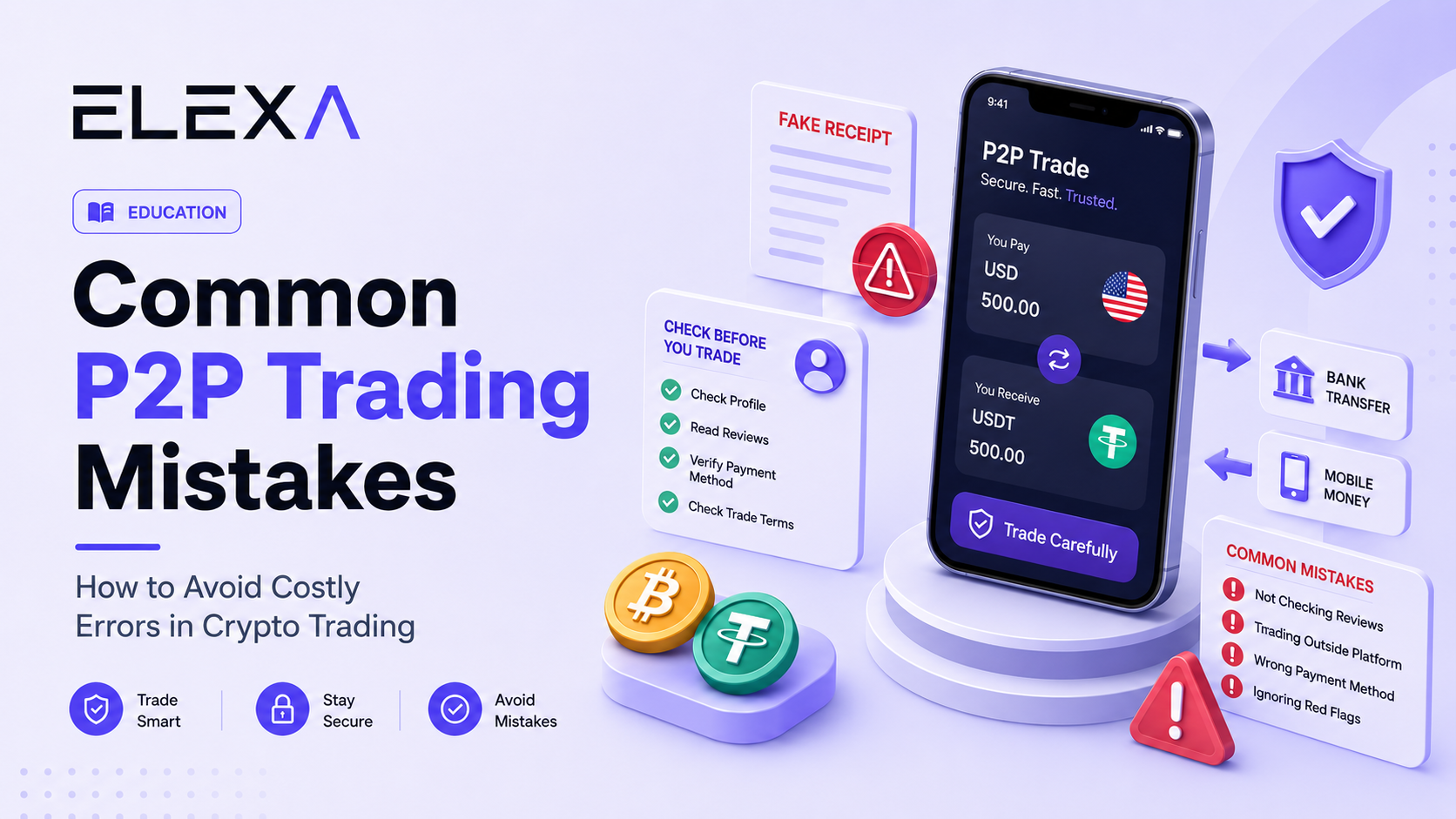
Common P2P Trading Mistakes: How to Avoid Costly Errors in Crypto Trading
Answer First
The most common P2P trading mistakes happen when users rush the process, ignore trade instructions, choose offers only by price, trust screenshots too quickly, move conversations outside the platform, or fail to keep proof of payment.
P2P crypto trading can be useful because it allows buyers and sellers to trade directly using multiple payment methods. But direct trading also requires more attention. Unlike a simple exchange order, a P2P trade often involves another person, a payment method outside the crypto platform, and a confirmation process.
To trade more safely, users should:
- Review the counterparty profile before starting a trade
- Read the offer terms carefully
- Use only the agreed payment method
- Never move the trade outside the platform
- Keep all payment evidence
- Avoid suspiciously cheap offers
- Confirm every step before continuing
- Start with small trades if they are new
- Use platforms with clear rules and dispute support
P2P trading is not only about finding the best price. It is about following a safe process.
Introduction
Peer-to-peer crypto trading gives users flexibility that traditional exchange methods may not provide. Buyers and sellers can trade directly, choose from different offers, use multiple payment methods, and negotiate within marketplace rules.
This flexibility is one of the biggest reasons P2P trading is popular, especially in regions where local payment methods are important.
But flexibility also creates responsibility.
In a P2P trade, users are not simply clicking a buy or sell button. They are interacting with another person or merchant. The buyer may need to send payment through a bank transfer, mobile wallet, payment app, or another method. The seller may need to confirm payment and complete the crypto side of the trade.
Because of this, small mistakes can lead to delays, disputes, or even losses.
Many P2P problems do not happen because the platform is complicated. They happen because users rush, skip instructions, trust the wrong evidence, or do not understand the trade flow.
This guide explains the most common P2P trading mistakes, why they happen, how they affect buyers and sellers, and how users can avoid them.
What Is P2P Trading?
P2P trading, or peer-to-peer trading, is a method of buying and selling cryptocurrency directly between users.
Instead of buying crypto directly from a centralized exchange, users trade with one another through a marketplace. One user creates an offer to buy or sell crypto, and another user accepts that offer.
A P2P marketplace may provide:
- User-created offers
- Multiple payment methods
- Buyer and seller profiles
- Trade instructions
- Reputation scores
- Dispute support
- Risk controls
- Transaction history
- Merchant verification
For example, a seller may create an offer to sell crypto. The buyer chooses the offer, follows the payment instructions, sends payment, and waits for the seller to complete the crypto side of the transaction according to the platform’s trade process.
Platforms such as Elexa are designed around direct P2P crypto trading, user-created offers, and structured marketplace rules.
Why Mistakes Happen in P2P Trading
P2P trading mistakes usually happen for a few reasons.
Users Focus Only on Price
Many beginners choose the cheapest or most profitable-looking offer without checking the counterparty profile, trade history, or terms. This can expose them to unreliable users or confusing trade conditions.
Users Rush the Trade
Scammers often create urgency. They pressure users to pay quickly, release quickly, cancel quickly, or continue outside the platform. Rushing is one of the easiest ways to make a costly mistake.
Users Ignore the Payment Details
P2P trades often depend on exact payment information. If the buyer sends the wrong amount, uses the wrong account, or ignores required instructions, the trade may become difficult to verify.
Users Trust Screenshots Too Easily
A payment screenshot is not always reliable. Screenshots can be edited, delayed, or misleading. Sellers should confirm payment directly from their own bank account or payment app.
Users Move Outside the Platform
Some users think private messages are faster. But once the trade moves outside the platform, the user may lose access to important dispute evidence and platform protection.
Mistake 1: Choosing an Offer Only Because It Has the Best Price
Price matters, but it should not be the only factor.
In P2P trading, a very attractive price can sometimes come with hidden risk. A seller may have unclear instructions, low completion history, slow response time, or a higher dispute rate. A buyer may offer a high price but use risky payment methods or third-party accounts.
Before choosing an offer, users should check:
- Counterparty profile
- Number of completed trades
- Completion rate
- Response time
- Payment methods
- Trade limits
- Offer terms
- User feedback
- Verification level
A slightly worse price from a reliable counterparty may be safer than the best price from an unknown or suspicious user.
How to Avoid This Mistake
Do not choose an offer based only on price. Compare price with trust signals.
A good offer should be clear, realistic, and supported by a counterparty profile that gives you enough confidence.
Mistake 2: Ignoring the Offer Terms
Every P2P offer may have specific rules. These rules are not just decoration. They define how the trade should happen.
Offer terms may include:
- Accepted payment method
- Payment time limit
- Account name requirements
- Minimum and maximum trade amount
- Required payment reference
- Third-party payment restrictions
- Instructions for proof of payment
- Conditions for release or confirmation
If a buyer ignores these terms, the seller may reject the payment or open a dispute. If a seller writes unclear terms, the buyer may become confused and the trade may fail.
Example
A seller may require payment from an account matching the buyer’s verified name. If the buyer sends payment from a friend’s account, the seller may refuse to complete the trade because third-party payments can create fraud risk.
How to Avoid This Mistake
Read the full offer before starting the trade. If you cannot follow the terms, choose another offer.
Mistake 3: Paying Outside the Platform Flow
One of the most dangerous mistakes is sending payment before the trade is properly started or outside the platform’s official process.
A scammer may say:
- “Pay me directly first.”
- “Let’s do it faster on Telegram.”
- “Send payment now and I’ll complete later.”
- “The platform is slow; we can finish outside.”
- “Cancel this trade and I’ll send you a better rate.”
This is risky because the platform may not be able to verify what happened if the official trade flow was not followed.
How to Avoid This Mistake
Only trade inside the platform. Only use the payment details shown in the active trade. Keep all communication inside the platform whenever possible.
If someone asks you to move outside the platform, treat it as a red flag.
Mistake 4: Not Keeping Proof of Payment
Payment evidence is critical in P2P trading.
If a dispute happens, users need clear records to show what happened. Without evidence, it may be difficult for the platform to review the case.
Useful proof may include:
- Transaction ID
- Payment receipt
- Bank confirmation
- Payment app confirmation
- Sender name
- Receiver name
- Amount
- Date and time
- Screenshots
- Screen recording, if needed
A buyer who pays but does not keep evidence may struggle to prove payment. A seller who cannot show account statements may struggle to prove non-receipt.
How to Avoid This Mistake
Save payment proof until the trade is fully completed. Do not delete receipts or close the trade chat too quickly.
Mistake 5: Trusting Fake or Edited Payment Receipts
Fake payment receipts are one of the most common risks in P2P trading.
A buyer may send an edited screenshot and claim payment has been made. The seller may feel pressured to complete the trade quickly. If the seller acts only based on the screenshot, they may release crypto without actually receiving money.
A screenshot is not the same as confirmed payment.
Sellers Should Check
- Actual account balance
- Transaction history inside the bank or payment app
- Sender name
- Exact amount
- Transaction status
- Whether the payment is pending or completed
How to Avoid This Mistake
Sellers should never complete a trade based only on a screenshot. Always verify the payment directly from your own account.
Mistake 6: Cancelling After Payment
This is a major mistake for buyers.
If a buyer has already sent payment, they should not cancel the trade unless the platform’s support team clearly instructs them to do so.
Scammers may pressure buyers with messages like:
- “Cancel first, then I will send crypto.”
- “The order is stuck; cancel and I’ll complete manually.”
- “Cancel so I can create a new trade.”
- “Don’t worry, I received your payment.”
If the buyer cancels after paying, the official trade record may become harder to resolve.
How to Avoid This Mistake
If you have already paid, do not cancel the trade. Use the dispute process and provide payment evidence.
Mistake 7: Using a Third-Party Payment Account
Third-party payments happen when the payment comes from an account that does not belong to the buyer.
For example, a buyer starts a trade but sends payment from a friend’s bank account. This can create serious problems for the seller and the platform.
Third-party payments may be linked to:
- Fraud
- Chargeback risk
- Stolen accounts
- AML concerns
- Ownership disputes
- Confusing evidence
Many sellers do not accept third-party payments, and many platforms restrict them.
How to Avoid This Mistake
Use a payment account that belongs to you. Check the offer terms before paying. If the seller requires name matching, follow that rule.
Mistake 8: Releasing Crypto Too Early
For sellers, releasing crypto too early can be costly.
A seller may release crypto because:
- The buyer sent a screenshot
- The buyer is pressuring them
- The buyer says the bank is slow
- The seller is in a hurry
- The seller misreads a pending notification
- The seller trusts the buyer’s message
Once crypto is released, it may be difficult or impossible to recover.
How to Avoid This Mistake
Only complete the crypto side of the trade after payment is fully confirmed according to the platform’s process and your payment account records.
Do not rely on promises.
Mistake 9: Trading With Unverified or Unknown Counterparties Without Caution
Not every new user is risky, but users should be more careful when trading with accounts that have little history.
A counterparty with no completed trades, unclear profile, or inconsistent information may require extra attention.
Trust signals matter in P2P trading.
Look for:
- Verified profile
- Completed trades
- Low dispute rate
- Good response behavior
- Clear offer terms
- Reasonable price
- Consistent payment details
How to Avoid This Mistake
Start with smaller trades when dealing with new or low-history users. For larger trades, choose stronger profiles.
Mistake 10: Ignoring Time Limits
P2P trades often have time limits for payment, confirmation, or response.
Ignoring these limits may cause:
- Automatic cancellation
- Delayed release
- Disputes
- Counterparty frustration
- Failed trades
- Lower reputation score
For example, if a buyer starts a trade but does not pay within the required time, the seller may cancel or dispute the trade. If a seller does not respond after payment, the buyer may open a dispute.
How to Avoid This Mistake
Start a trade only when you are ready to complete it. Do not open trades casually and leave them inactive.
Mistake 11: Not Understanding Payment Method Risk
Not all payment methods have the same risk level.
Some payment methods are fast but may be reversible. Others are slower but more final. Some require exact name matching. Some may show pending status before final settlement.
Sellers should understand the payment methods they accept. Buyers should understand how proof and confirmation work.
Payment method risk may include:
- Reversal risk
- Chargeback risk
- Delay risk
- Third-party account risk
- Pending status confusion
- Proof verification difficulty
How to Avoid This Mistake
Use payment methods you understand. If you are a seller, avoid accepting payment methods that you cannot verify properly.
Mistake 12: Moving Communication to Telegram or WhatsApp
Many P2P scams happen when users move from the platform chat to private messaging apps.
A scammer may do this to:
- Avoid platform monitoring
- Hide evidence
- Pressure the user
- Send fake links
- Ask for off-platform payment
- Manipulate the trade record
If a dispute happens, private messages may be harder to verify or may not be accepted as strong evidence.
How to Avoid This Mistake
Keep important communication inside the platform. Never click suspicious links shared outside the official platform.
Mistake 13: Using the Wrong Network or Address
Crypto transfers are usually irreversible. Sending crypto to the wrong address or network can lead to permanent loss.
Common mistakes include:
- Sending USDT on the wrong network
- Copying the wrong wallet address
- Sending unsupported assets
- Ignoring minimum deposit amounts
- Using an address from a previous or unofficial source
- Sending to an address shared in private chat
How to Avoid This Mistake
Always check:
- Asset
- Network
- Address
- Minimum deposit
- Required confirmations
- Platform deposit page
If you are new, start with a small test transaction.
Mistake 14: Not Testing the Platform With a Small Amount
New users sometimes deposit or trade large amounts before understanding how the platform works.
This can create stress if they are unfamiliar with confirmations, trade steps, payment rules, withdrawal reviews, or dispute processes.
How to Avoid This Mistake
Start small. Make a small deposit, complete a small trade, and test withdrawal before using larger amounts.
A trustworthy process should be tested step by step.
Mistake 15: Ignoring Risk Notices
Risk notices may seem boring, but they exist for a reason.
They explain things like:
- Network risks
- Payment risks
- Trade cancellation rules
- Dispute evidence requirements
- Withdrawal review conditions
- User responsibility
- Restricted activity
Ignoring these notices can lead to avoidable mistakes.
How to Avoid This Mistake
Read platform warnings, especially before deposits, withdrawals, payments, and trade confirmations.
Buyer Checklist: Before You Pay
Before sending payment in a P2P trade, check:
- Is the trade active inside the platform?
- Are the payment details correct?
- Does the payment method match the offer?
- Is the seller profile reliable?
- Are the trade limits correct?
- Have you read the offer terms?
- Are you paying from your own account?
- Do you understand what to do if the seller does not complete the trade?
- Can you keep proof of payment?
If something feels wrong, do not proceed.
Seller Checklist: Before You Complete the Trade
Before completing the crypto side of the trade, check:
- Has payment actually arrived?
- Is the amount exact?
- Does the sender name match the expected buyer?
- Is the payment final, not pending?
- Are there any suspicious messages?
- Is the buyer asking to move outside the platform?
- Is the buyer pressuring you?
- Do you have enough evidence if a dispute happens?
Never complete a trade based only on a screenshot.
What to Do If Something Goes Wrong
If a trade does not go as expected:
- Stay calm.
- Do not move the conversation outside the platform.
- Do not cancel after payment.
- Collect evidence.
- Use the platform’s dispute process.
- Provide clear information.
- Follow support instructions.
- Avoid making side agreements with the counterparty.
Disputes are easier to review when the trade history, messages, payment proof, and transaction details are clear.
How Platforms Can Help Reduce P2P Mistakes
A good P2P marketplace should help users avoid mistakes through product design and education.
Useful platform features include:
- Clear offer terms
- Counterparty profiles
- Trade status indicators
- Payment warnings
- Deposit and withdrawal notices
- Reputation scores
- Dispute support
- Merchant verification
- Risk-based checks
- Educational content
- Warnings against off-platform deals
For example, a P2P Marketplace can help users trade with more structure by offering user-created offers, merchant profiles, clear trading rules, and support processes.
FAQ
What is the most common mistake in P2P trading?
One of the most common mistakes is rushing the trade without checking the counterparty profile, offer terms, and payment details.
Is the cheapest P2P offer always the best?
No. The cheapest offer may come with higher risk. Always check the counterparty’s profile, history, terms, and reputation.
Should I trust payment screenshots?
No. Sellers should verify payment directly from their own bank account or payment app before completing the crypto side of the trade.
What should I do if I paid but the seller does not complete the trade?
Do not cancel the trade. Open a dispute and provide clear payment evidence.
Is it safe to trade outside the platform?
Trading outside the platform is risky. You may lose access to official trade records, dispute support, and platform rules.
Can I use someone else’s payment account?
Only if the platform and counterparty allow it. Many P2P traders reject third-party payments because they create fraud and compliance risks.
Why should beginners start with small trades?
Small trades help beginners understand deposits, payment flow, trade confirmation, dispute process, and withdrawals before using larger amounts.
What should sellers check before completing a trade?
Sellers should confirm the exact payment amount, sender details, final payment status, and account balance before completing the trade.
What should buyers check before paying?
Buyers should check the seller profile, offer terms, payment details, trade status, and evidence requirements before paying.
How can I reduce P2P trading risk?
Use trusted counterparties, follow platform rules, keep evidence, avoid off-platform deals, start small, and never rush the process.
Conclusion
P2P trading can be flexible, practical, and useful, especially for users who want to buy or sell crypto directly using multiple payment methods.
But P2P trading also requires careful behavior.
Most mistakes happen when users rush, ignore instructions, trust weak evidence, trade outside the platform, or focus only on price.
The safest P2P traders follow a process. They check the counterparty, read the terms, confirm payment details, keep evidence, avoid private deals, and use the platform’s dispute process when needed.
For beginners, the best approach is simple: start small, learn the flow, and increase activity only after understanding how the platform works.
P2P trading is not just about speed or price. It is about trust, process, and discipline.
Soft CTA
If you want to trade crypto directly with more structure, you can explore available offers on Elexa. Elexa is built for direct P2P crypto trading, user-created offers, merchant profiles, and clear trading rules.
When you are ready to trade on your own terms, you can also Create an Offer and set your preferred price, limits, and payment methods.
